

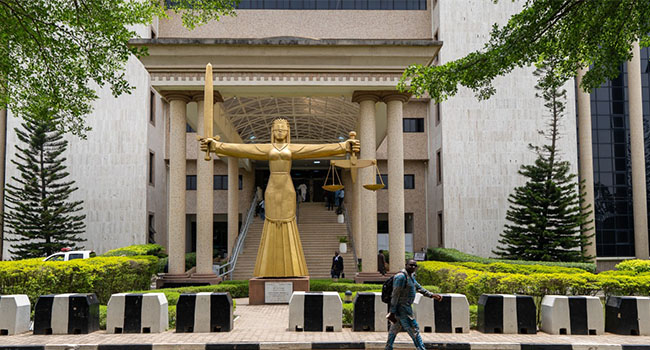
Justice Joyce Abdulmalik of the Federal High Court Abuja, has barred the Independent National Electoral Commission (INEC) from recognising or participating in any congress organised by a disputed leadership of the African Democratic Congress (ADC).
Justice Abdulmalik also restrained former Senate President David Mark and other party figures from interfering with the functions and tenure of elected state executives.
The ruling followed an originating summons filed by Norman Obinna and six others on behalf of ADC state chairpersons and executive committees.
They challenged the legality of actions taken by an interim national leadership.
The plaintiffs argued that it lacked the constitutional authority to organise state congresses or appoint committees for that purpose.
They asked the court to affirm their tenure and stop any parallel process.
‘Issue Meritorious’
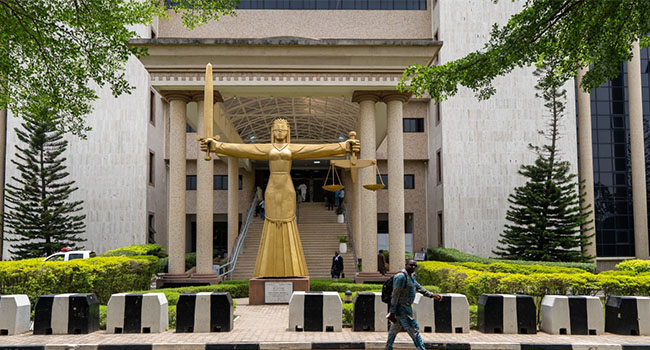
A man walks past the Federal High Court premises in Abuja, on April 22, 2026. (Photo by LIGHT ORIYE TAMUNOTONYE / AFP)
In her judgment, Justice Abdulmalik noted that she found “the issue in the originating summons meritorious”.
She said the germane issue was whether the second to sixth defendants, including Mark, had constitutional or statutory authority to assume the powers of an elected state organ of the ADC, whose tenure is constitutionally guaranteed.
According to her, section 223 of the 1999 Constitution provides that political parties shall conduct periodic elections on a democratic basis, while article 23 of the party’s constitution provides that national and state officers shall hold office for a maximum of two terms of eight years.
The judge, therefore, said that “the question is whether there is any infraction committed by Mark and co-defendants when they convened meetings and appointed a body known as a congress committee to organise state congresses”.
On the issue of internal affairs of political parties raised by the defendants, she noted that “the law is settled that courts will not interfere. However, where there is an allegation of breach of constitutional or statutory provisions, the court has a duty to intervene.”
“Where a party alleges that its constitution has been violated, the court is bound to adjudicate. Any argument that this court lacks jurisdiction on that basis fails,” she ruled.
‘Parties Must Comply With Their Constitutions’
She held that political parties must comply strictly with their constitutions and that courts can intervene where there is a breach of constitutional or statutory provisions.
She found that the procedure adopted by the defendants, including the appointment of a “congress committee,” is not recognised by the party’s constitution.
The judge ruled that the tenure of state executive committees remains valid and must be allowed to run its course.
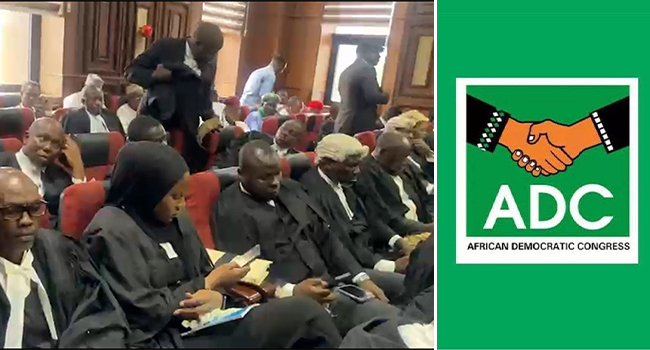
She also said that only those elected structures have the authority to organise state congresses.
The court set aside the appointment of the committee and restrained INEC from recognising any congress organised by it.
The court also restrained Mark and other defendants from organising congresses or conventions outside the provisions of the party’s constitution.
The judge further restrained them from taking steps that could undermine or disrupt the authority of the state executive committees.
The suit was instituted by way of originating summons by the plaintiffs, led by Obinna and six others.
They sued on behalf of state chairmen and executive committees of the ADC.
The defendants include the ADC, Mark, Patricia Akwashiki, Bolaji Abdullahi, Rauf Aregbesola, Oserheimen Osunbor, and INEC.
The plaintiffs challenged the legality of caretaker or interim national working committees and urged the court to restrain INEC from recognising or participating in any congress organised by the caretaker committee.
The plaintiffs further contended that, under the party’s constitution and the 1999 Constitution (as amended), the tenure of state executive committees subsists until valid congresses are conducted, and that any attempt to bypass them undermines internal party democracy.
However, the defendants, in preliminary objections, counter-affidavits, and written addresses, urged the court to dismiss the suit.
Mark and others argued that the matter relates to internal affairs of a political party, is not justiciable, that the plaintiffs lack locus standi, and that the suit is incompetent.
Jurisdiction
Before delivering judgment, the court also ruled on the preliminary objections and counter-affidavits filed by the defendants.
On jurisdiction, Justice Abdulmalik held that “the subject matter of the plaintiff’s action pertains to the affairs of INEC,” and therefore falls within the jurisdiction of the Federal High Court under section 251 of the Constitution.
On the argument that the plaintiffs failed to exhaust internal dispute resolution mechanisms, the judge declined to uphold the objection at that stage.
She held that determining that issue would amount to deciding substantive questions prematurely.
On locus standi, she held that “the plaintiffs’ locus standi and capacity emanate from the alleged violation” and that they share a common grievance, making the representative action proper.
Consequently, she held that the objections lacked merit and were resolved in favour of the plaintiffs.
The post Court Bars INEC From Recognising ADC State Congresses appeared first on Channels Television.