
For Europe’s politicians, the downside of relying on the U.S. for European security is becoming ever more painfully obvious. The situation is just as awkward for the continent’s bankers.
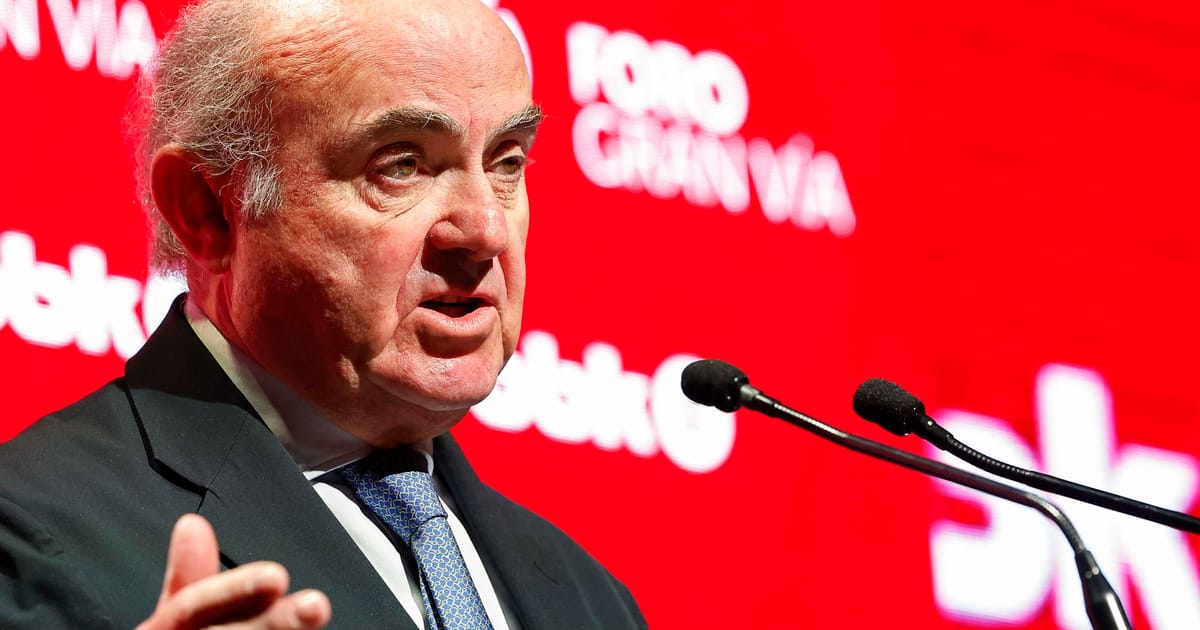
In an interview with POLITICO earlier this week, European Central Bank Vice President Luis de Guindos insisted that the ECB still trusts the U.S. Federal Reserve to be a reliable lender of last resort to its peers, despite signs that an administration that has kicked over the traces in every other area of international policy in the last year is now targeting the Fed’s leadership.
“We believe that the question of the swap lines [between the Fed and other central banks] and the delivery of dollars is something that is positive for financial stability on both sides of the Atlantic, and that’s why we firmly believe that that cooperation will continue,” de Guindos said ahead of one of his last formal hearings at the European Parliament on Thursday. His eight-year term ends on May 31.
For the last century, the U.S. has been the world’s effective lender of last resort. While that role has typically been mediated through the International Monetary Fund, more recently — notably in 2008 and in 2020 — it has been the Federal Reserve that has stood directly between the world and financial meltdown, making vast amounts of dollars available to other central banks at moments of panic to keep the system from collapse.
Under Jerome Powell there had been no doubt internationally that the Fed would step up again if another crisis threatened. But Powell — whose term as Fed chair ends in May — is now under criminal investigation by the U.S. Department of Justice. The probe is seen both at home and abroad as part of a broader pressure campaign to put the central bank under the effective control of U.S. President Donald Trump. At which point, seemingly, all bets on international cooperation would be off.
Sunday’s news from the U.S. was scary enough to prompt central bankers from South Korea to Europe and Australia to issue a joint statement in support of Powell on Tuesday — a reflection, analysts said, of fears that politicizing the Fed could lead to higher U.S. inflation, higher market interest rates and higher all-round volatility.
“The attacks on the Fed have a domestic impact of course … but they have an international application because the dollar is the anchor of global financial stability,” José Manuel González Paramó, a former ECB board member now teaching at the IESE business school in Spain, told POLITICO.
De Guindos defended what has been an unchallenged assumption for the last 40 years: that leaving a central bank to set interest rates free from political direction is the best guarantee of low inflation.
The best evidence, he argued, is from the markets, whose setting of long-term interest rates through bond yields reflects the degree of confidence in the ability of a currency to keep its value.
“The yield curve for an independent central bank is always below that of a non-independent one,” De Guindos said.
Powell’s last three predecessors, in their own joint statement on Tuesday, put it more scathingly, saying the move against Powell “is how monetary policy is made in emerging markets with weak institutions, with highly negative consequences for inflation and the functioning of their economies more broadly.”
Hope is not a strategy
De Guindos stressed that the ECB remains “the main player in terms of guaranteeing financial stability” in the euro area. The Spaniard dismissed a report from late last year that said central banks in Europe are considering ways to pool their dollar reserves to reduce their dependence on the Fed. Neither the ECB’s Governing Council nor its Executive Board in Frankfurt had discussed any such plan, he said.
While he acknowledged a POLITICO report that the ECB is working with central banks in the European neighborhood to beef up euro liquidity lines that would strengthen the region’s safety nets, he said this was “only a part” of its work and “not the most relevant one.”
De Guindos also argued that there are other ways Europe’s financial stability could be threatened, irrespective of the Fed. U.S. control over online data storage, known as cloud computing, and payments infrastructure also pose potentially grave risks.
“These are areas where we believe that we should be more independent because the paradigm has changed, the attitude of the U.S. is different, and I think that Europe has to — and is going to — react to that,” he said.
Keeping the guard up
The proliferation of such risks is perhaps one reason the ECB chose not to recommend a reduction in capital requirements for EU banks when it presented its ideas for simplifying regulation of the sector at the end of last year. Bank share prices have roared to multiyear highs across Europe in the last couple of years, as profits and balance sheets have recovered spectacularly. The ECB’s recommendations disappointed banks that had hoped to be able to reward long-suffering shareholders after a decade of meager returns.
De Guindos will be defending those recommendations later on Thursday before the European Parliament’s Economic and Monetary Affairs Committee.
De Guindos repeated to POLITICO what he had said in December, that there is no suggestion in the ECB’s own frequent surveys of lending officers that current capital requirements are restricting the flow of credit to the economy. Moreover, he said, “We believe that the level of capital and the solvency of European banks is one of the few competitive advantages that Europe has over other jurisdictions at this time.”
He accepted that the European Commission may well want to tweak some of the Bank’s recommendations as it works on a broader plan for lightening the regulatory burden for the EU’s economy this year.
“We will continue discussing with them if they want to enter into more concrete details, for sure, and we will be totally open to cooperating with them,” De Guindos said.
Johanna Treeck and Kathryn Carlson contributed to this report from Frankfurt and Brussels.