
Hundreds of robotaxis suddenly freeze trapping their passengers on motorway

To view this video please enable JavaScript, and consider upgrading to a web
browser that
supports HTML5
video

Up Next

Up to 200 robotaxis broke down on a major motorway in China, trapping countless passengers.

A ‘system malfunction’ caused the driverless cabs to stop along three major roads in Wuhan, a large city in central China, on Tuesday.

Videos posted on the Chinese social media network Weibo show riders screaming for help inside dozens of vehicles with blinking headlights.

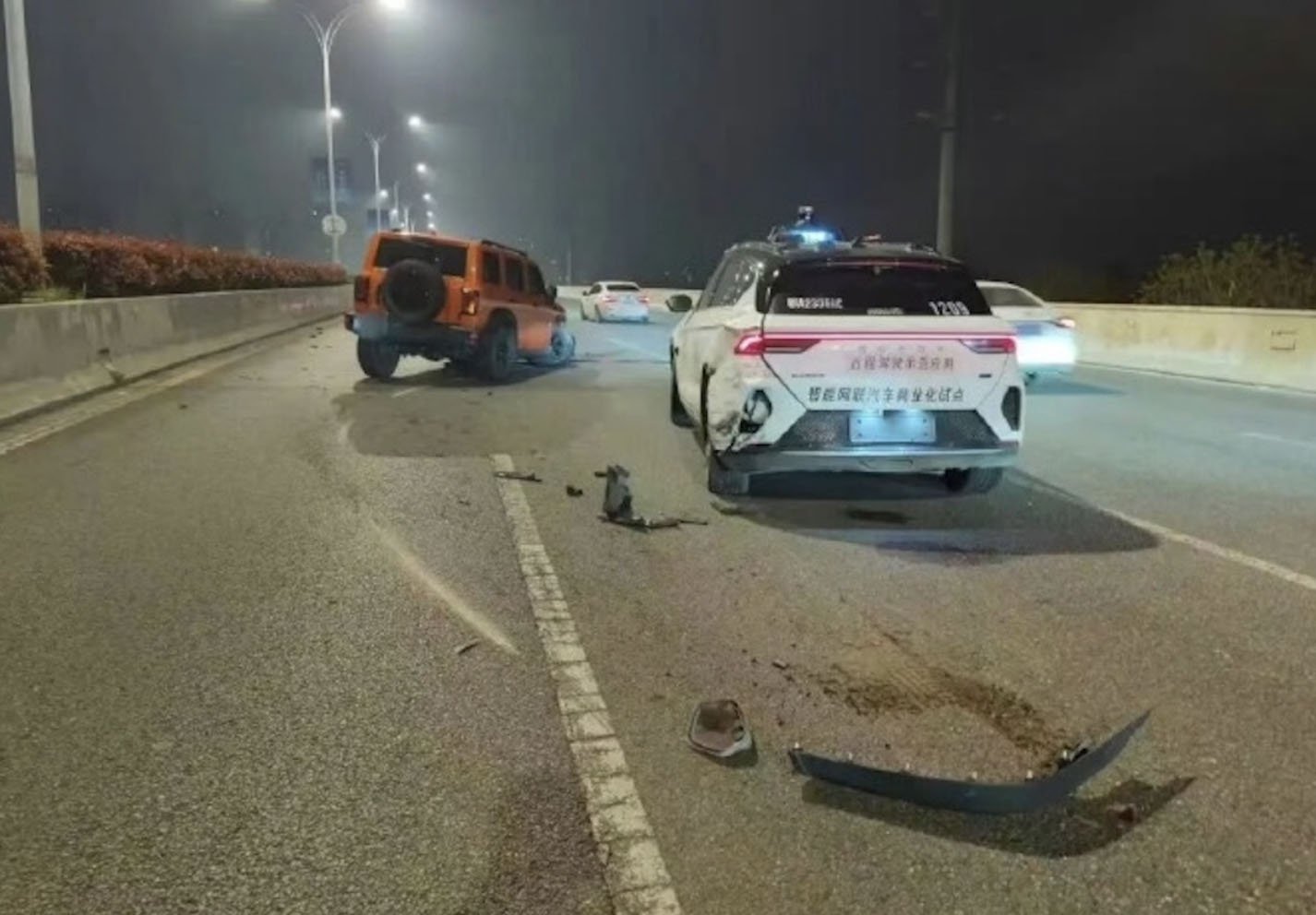
One photograph showed the tax in the road that appears to have been hit by an orange and badly damaged truck.

Another customer could do nothing as trucks roared past them; their car stopped in the slowest lane of an expressway.

One rider stranded for one hour said on the Chinese TikTok rival Xiaohongshu that the SOS button and onboard help were ‘useless’.

Story from Jam Press (Stranded Robotaxi Fleet) Pictured: A stranded robotaxi that was hit by a car. Over 100 robotaxis were left stranded on roads across a major city after a system blunder. The malfunction led to multiple crashes and clients being locked inside stopped vehicles. It is the first time a mass shutdown of driverless taxis has been reported in China. The system malfunction took place in Wuhan, China, at around 9pm on Tuesday (31 Mar). A message on the vehicle?s screen read: ?Driving system malfunction. Staff are expected to arrive in five minutes.? While many passengers were able to get out without incident, dozens of passengers were left locked inside for over an hour. One person said it took half an hour just to connect to a company representative. Over 100 Apollo Go vehicles, which use the Baidu Apollo autonomous driving platform, were reportedly affected by the centralised system malfunction. Despite causing traffic chaos all over Wuhan, no injuries were reported. Baidu, a Chinese internet and AI company that operates over 1,000 robotaxis in the country, has yet to comment on the mishap. The cause of the malfunction is still under investigation. The mass shutdown exposed the risks of over-reliance on centralised control systems for driverless vehicles. It also raised national security concerns over the ability to hack an entire fleet of vehicles remotely. Baidu is planning to expand its Apollo Go service to Europe. They launched their driverless taxi service in Dubai and Abu Dhabi earlier this year, as reported by Creatorzine.com. Their self-driving car initiative uses four-seater cars fitted with 12 cameras, LiDAR, radar, ultrasonic sensors, and is capable of Level 4 autonomy. In December 2025, a fleet of Waymo's self-driving cars came to a stop in San Francisco, US, due to a power outage. ENDS EDITOR?S NOTES: Usage Licence: (SOCIAL MEDIA) We have obtained this material from a verified account on social media platforms and have reached out to the owner. Usage Restrictions: Jam Press accepts all responsibility for use on news media portals only, usage on social media platforms like Facebook and YouTube is not guaranteed.
The exact number of impacted vehicles is unclear, but one officer said it was between 100 and 200 (Picture: JamPress)
Story from Jam Press (Stranded Robotaxi Fleet) Pictured: A video grab of a stranded robotaxi. Over 100 robotaxis were left stranded on roads across a major city after a system blunder. The malfunction led to multiple crashes and clients being locked inside stopped vehicles. It is the first time a mass shutdown of driverless taxis has been reported in China. The system malfunction took place in Wuhan, China, at around 9pm on Tuesday (31 Mar). A message on the vehicle?s screen read: ?Driving system malfunction. Staff are expected to arrive in five minutes.? While many passengers were able to get out without incident, dozens of passengers were left locked inside for over an hour. One person said it took half an hour just to connect to a company representative. Over 100 Apollo Go vehicles, which use the Baidu Apollo autonomous driving platform, were reportedly affected by the centralised system malfunction. Despite causing traffic chaos all over Wuhan, no injuries were reported. Baidu, a Chinese internet and AI company that operates over 1,000 robotaxis in the country, has yet to comment on the mishap. The cause of the malfunction is still under investigation. The mass shutdown exposed the risks of over-reliance on centralised control systems for driverless vehicles. It also raised national security concerns over the ability to hack an entire fleet of vehicles remotely. Baidu is planning to expand its Apollo Go service to Europe. They launched their driverless taxi service in Dubai and Abu Dhabi earlier this year, as reported by Creatorzine.com. Their self-driving car initiative uses four-seater cars fitted with 12 cameras, LiDAR, radar, ultrasonic sensors, and is capable of Level 4 autonomy. In December 2025, a fleet of Waymo's self-driving cars came to a stop in San Francisco, US, due to a power outage. ENDS EDITOR?S NOTES: Usage Licence: (SOCIAL MEDIA) We have obtained this material from a verified account on social media platforms and have reached out to the owner. Usage Restrictions: Jam Press accepts all responsibility for use on news media portals only, usage on social media platforms like Facebook and YouTube is not guaranteed.
Motorists said they saw several of the lone robocabs while driving through Wuhan (Picture: JamPress)

‘I called their customer service number nearly 20 times from my own phone and still couldn’t get through,’ the user, Luka, said, with a video showing the button not working.

‘Is there any way to file a complaint? I’m speechless.’

She added in a second video that customer service representatives offered her a 50% coupon as compensation.

One dashcam recording posted to Rednote shows a car passing 16 autonomous vehicles parked on the road in only 90 minutes.

The glitched cars were part of Apollo Go, a self-driving ride-hailing scheme run in Wuhan by the Chinese internet company Biado.

One police officer told local media that between 100 and 200 robotaxis stalled, which is a ‘common problem’ with Apollo Go cars.

This file photo taken on August 1, 2024 shows a general view of a driverless robotaxi autonomous vehicle developed as part of tech giant Baidu's Apollo Go self-driving project, in Wuhan, in central China's Hubei province. A string of self-driving robotaxis owned by Chinese internet giant Baidu stalled in central China, stranding passengers after an apparent "system malfunction", police said on April 1,2026. (Photo by PEDRO PARDO / AFP via Getty Images)
The fleet of robotaxi autonomous vehicles was developed for Baidu’s Apollo Go self-driving project in Wuhan (Picture: AFP)

The officer added: ‘Passengers can press a button and the door can open, but they can’t get off or get off the ring road. We saved many people today.’

Police have not revealed what caused the malfunctions along the Second and Third Ring Roads and the Baishazhou Bridge at 8.57pm.

No one was injured and all passengers have exited the vehicles.

The police added: ‘Following established contingency plans, the public security traffic control and transportation departments quickly mobilised forces to the scene to dispose of the situation in coordination with Apollo Go company staff.’

Baidu has been approached for comment.

The incident comes as many cities across the world embrace cars with self-driving technology, including in London.

To view this video please enable JavaScript, and consider upgrading to a web
browser that
supports HTML5
video

Up Next

But these trials haven’t been without speed bumps. Passengers of self-driving Waymo cars in San Francisco say that their trips have been cut short because of vandals or those opposed to robot cars.

In 2024, a man covered the sensors of the robotaxi that had stopped. The cars stop moving when a person is nearby as a safety precaution.

Other passengers say they have become trapped inside while their cab is being tagged by graffiti artists or when a man asked for her phone number.

Get in touch with our news team by emailing us at webnews@metro.co.uk.

For more stories like this, check our news page.

Leave a Reply

Your email address will not be published. Required fields are marked *