

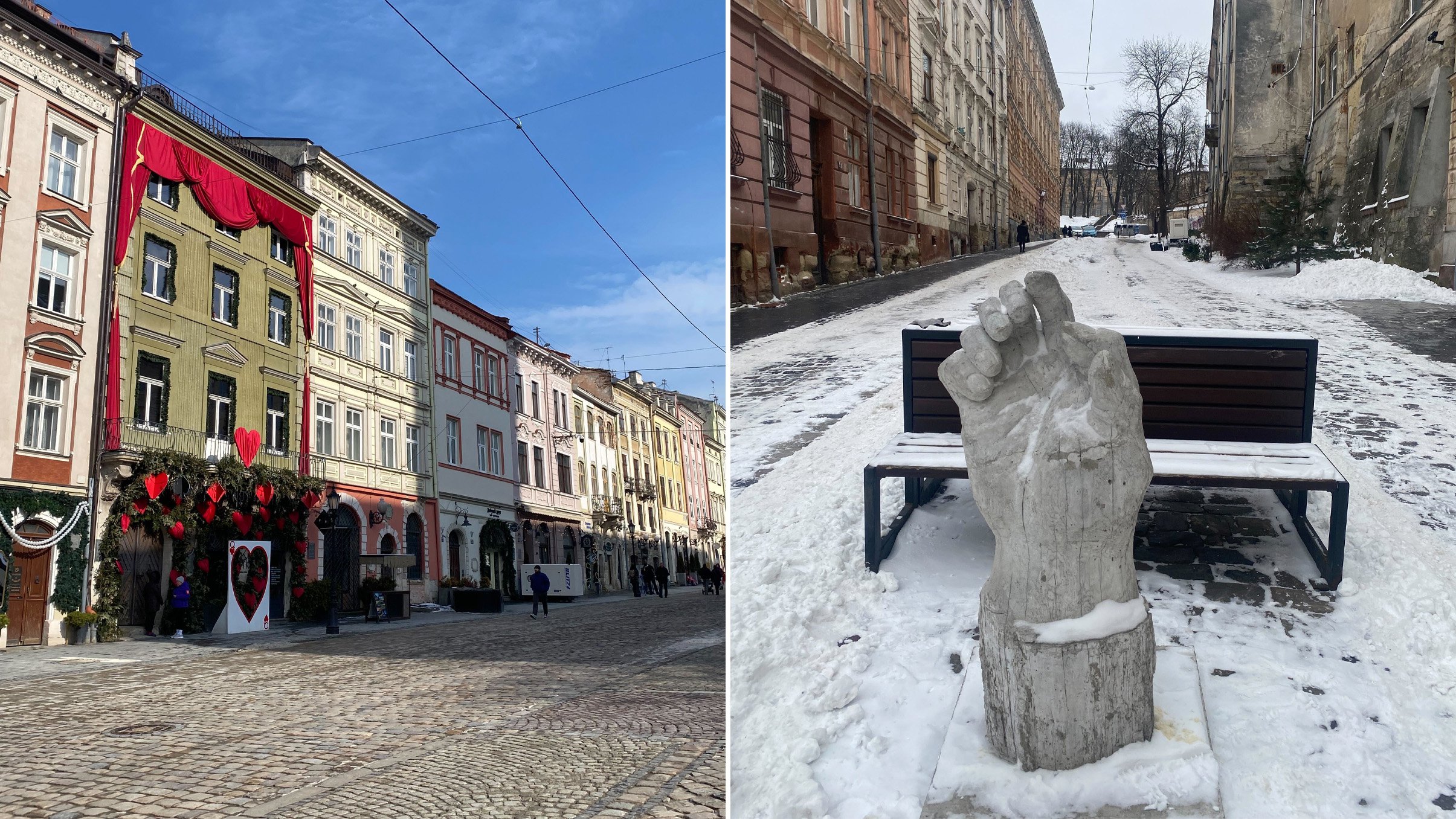

Walking through the snow-dusted streets, life in Lviv seems normal. People are walking their dogs, shopping for toilet roll, drinking coffee with friends.
But if you look closer, the scars start to show. It’s been four years since Russia launched its invasion of Ukraine, and while the city is in the west of the country, 600 miles from the frontline, the toll of war is clear.
Monuments are covered with metal cages for protection from attacks. Buildings hollowed by shelling are draped in plastic sheets. A curfew is in place from midnight to 5am, and each morning, the city grinds to a standstill for a minute’s silence.
Winter has always been difficult in Ukraine, but this year has been the coldest in decades.
January saw the lowest temperature in 16 years, and millions face daily life without drinking water and reliable electricity after repeated attacks on the country’s energy infrastructure. Keeping warm is a full-time job.
When I visited Lviv in February, it was a bone-chilling -10°C. I was there as a volunteer with Driving Ukraine, an organisation that sends cars to the frontline.
Best of Metro Deals
Get exclusive discounts with Metro Deals – save on getaways and spa days. Powered by Wowcher
Bannatyne Spa: Spa day for two with treatments, lunch & prosecco — save up to 57% off.
Mystery Escape: Hotel stay with return flights from as low as £92pp — save on worldwide holiday packages.
Beach Retreat (Lanzarote): 4* Lanzarote beach holiday with flights — save up to 58%.

There were almost 30 of us, all working together to make sure that the 10 vehicles in our convoy made it to Lviv, where they’d be handed straight to the people who needed them.
Many end up with military medics working along the frontlines, or in humanitarian bomb disposal and air defence teams.
And it was our job to make sure they made it from our starting point in Oxfordshire.
Just an hour’s drive from Katowice in Poland, Lviv is considered relatively safe in Ukrainian terms. It is subject to regular aerial attacks but is far from the frontline, about the same distance as London to Berlin.
It’s easily accessible by car or train if you’re willing to brave the loosely organised chaos that is the border — and the lengthy paperwork.

Our journey was not without hiccups. There were sore backs, sleepless nights and a break down on the side of a motorway in Germany.
But after 1,300 miles, we arrived in Lviv to a group of Ukrainians who looked delighted to see us. When we passed our car to the soldier it was destined for, his wife hugged me.
She thanked us for the Toyota Land Cruiser, but more so for the chance we gave her to be with her husband who she hadn’t seen in months.
Driving Ukraine was founded by Fynn Watt and Maksym Sosliuk in the early days of the war in 2022.
Since then, Maksym, 25, tells Metro that war has changed Lviv beyond recognition.
Despite growing up here, he says any memory of what it was like before feels foggy to him now.

Lviv’s old town, built in the 1200s, is an architectural marvel of ornate churches, wide boulevards and a grandiose UNESCO-protected opera house.
He remembers Rynok Square being thronged by international tourists, from Poland, Germany and right across Europe, with a lively atmosphere and street musicians with guitars in hand.
People are still coming to Lviv (more on that later), but much fewer from abroad.
Air alerts
Before the trip, I downloaded Ukraine’s ‘Air Alert!’ app, which warns of incoming missiles and drone strikes.
As Lviv is in the west of Ukraine, the furthest city from the frontline, air alerts aren’t as common as they are in places like Kyiv, Dnipro, Donetsk, and Zaporizhzhia.

But at 6am the next morning, my phone buzzes. There’s a drone flying over the city, and we see soldiers trying to shoot it down. At 9am, there’s another to say that it’s over.
That afternoon, we drive to the Field of Mars, a memorial to fallen soldiers in Lychakiv Cemetery.
It’s where every person from Lviv killed on the frontlines ends up. There are rows and rows – more than 1,000 – of graves, all with names, pictures, and Ukrainian flags.
What does the UK Foreign Office say about travelling to Ukraine?
The UK Foreign Office advises against all travel to parts of Ukraine, specifically Crimea, and within 50km (about 31 miles) of the border with Belarus in the Volyn, Rivne, and Zhytomyr regions.
It advises against all but essential travel to Zakarpattia, Ivano-Frankivsk, Ternopil, Chernivtsi, and Lviv in the West.
The guidance adds that British citizens who do choose to travel should keep an eye on local media, be aware of their nearest shelters, and pay attention to air alerts. Ukrainian airspace is closed, so you cannot fly there.
Dark tourism
While international tourism in Lviv has dried up, domestic tourism has actually increased.
Statistics from the Lviv Tourism Office show that before the war, the city attracted between 1.5 and 2 million visitors each year, from around 150 countries.
In 2024, around 1.7 million people came to Lviv, of which about 88% were domestic and just 12% were international tourists.
Last year, Ukraine’s tourism rose to 27% more than pre war levels. Lviv was the second most visited city after Kyiv.

The only foreigners I met in Lviv were fellow volunteers, from several countries including the US, the Netherlands, Spain and France.
But scrolling on Instagram and TikTok, it’s clear that international travel influencers, historians and ‘dark tourists’ continue to visit Ukraine, contrary to Foreign Office advice.
Creators with large followings who have visited in recent months include Andrew Wigham, a British blogger and war historian.
Dark tourism, which involves visiting conflict zones and places of tragedy, existed in Ukraine before the 2022 Russian invasion.
The Chernobyl nuclear power plant has long been a magnet for dark tourists, so much as that guided tours were launched of Pripyat, the neighbouring abandoned village.
Now, you can take similar tours of military attack sites. The Donbas war tour, for instance, takes visitors to the frontlines of the conflict and offers ‘a firsthand look at the impact of the war on the local population’, introducing them to displaced locals, soldiers and volunteer fighters.
There’s also a Kyiv tour, which takes in destroyed military equipment and what remains of missile strikes.
Meanwhile in Lviv, staff at the tourism office tell me that the city is working on developing sustainable and accessible tourism while supporting locals and residents.
Ukraine’s culinary capital
In another world, it’s easy to imagine Lviv as one of Europe’s premier food destinations.
Famous for its chocolate, coffee, and eclectic restaurants that serve local and international cuisine, it is the gastronomic capital of Ukraine.
There are cosy French bistros, cool wine bars and top restaurants which could genuinely rival their equivalents in London or Paris at a tenth of the price.

I taste some of the city’s culinary magic at Lviv Croissants, a local institution that gifts us bags of goodies, mainly moreish croissants stuffed with chicken, lettuce, and tomato.
There’s so much to go around that there’s enough for seconds.
At Inshi, a Ukrainian restaurant that specialises in traditional dishes, we try potato pancakes with catfish, Varenyky (dumplings filled with potato and onion), and the eastern staple: borscht.
Brunch is a delight at Cukor Black (I have eggs royale and a cappuccino), and at Lviv Handmade Chocolate, the staff help me pick out something special to take home.

Our last stop is 1708 Pizza Di Napoli, which serves things like beef tartare, burrata, and shrimp in a creamy bisque sauce.
The food is delicious and great value, but aside from our table, the restaurant is quiet. Many of them are.
I wonder how long the businesses – and the people – can continue.
Support Driving Ukraine's work
At the time of writing, Driving Ukraine has delivered 300 vehicles to Ukraine, run 53 convoys, and fundraised more than £2.1 million.
If you’d like to get involved in a mission or donate towards the cost of a vehicle, you can do so on the Driving Ukraine website.
Do you have a story to share?
Get in touch by emailing MetroLifestyleTeam@Metro.co.uk.