

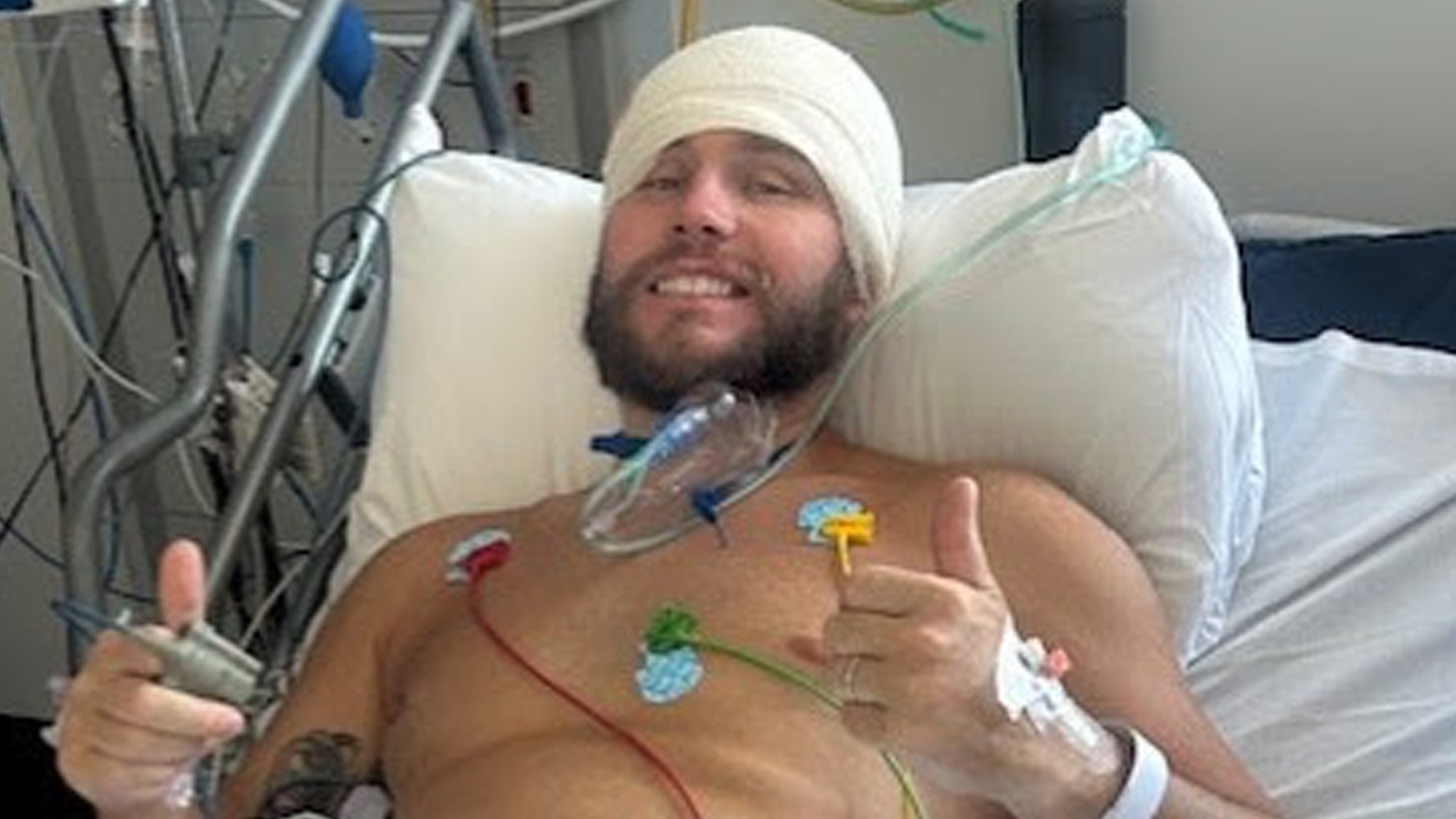

Lewis Goodfield had already been admitted to hospital twice for bad stomach pains when he collapsed in agony in his A&E department in March last year.
At just 37 years old, the father-of-two had been suffering with severe ‘relentless’ abdominal pains for years and was at his breaking point.
But this third hospital visit led to a diagnosis he never expected: a brain tumour.
‘I collapsed in pain while in hospital and nurses assumed I’d had a seizure,’ Lewis, from Beddau, Wales, says. ‘Then a CT scan showed a mass on my brain.
‘It was a huge shock – not just for me but for friends and family, too. It hit me hard.’
In April, the services engineer was told by his doctors he had a grade two glioma, a slow-growing brain tumour which often progresses to a higher grade (faster-growing) tumour over a span of years.
But it was chance that led to his diagnosis, because his bad stomach pains are believed to be entirely unrelated.
‘It was a massive shock,’ Lewis says, recalling the moment he was told about the mass. ‘[But] it wasn’t aggressive.’
![Story from Jam Press (Brain Tumour Diagnosis) Pictured: Lewis with wife Keeley and children Jake and Ralph. ?Test for stomach ache found tumour growing in my BRAIN ? I had surgery while AWAKE to remove it? A man has shared how a simple test for stomach pain resulted in a life-changing diagnosis. Lewis Goodfield had been struggling with abdominal issues for ?several years? ? so much so that the pain had become ?relentless?. When he couldn?t take any more, the services engineer was admitted to hospital with abdominal pains ? but news of a brain tumour was the last thing he was expecting. ?I collapsed in pain while in hospital and nurses assumed I?d had a seizure,? the 37-year-old, from Beddau, Wales, told creatorzine.com. ?Then a CT scan showed a mass on my brain. ?It was a huge shock ? not just for me but for friends and family, too. ?It hit me hard.? Lewis had been focused on getting answers to his stomach issues and never expected to be told something so life changing. The father-of-two had already been admitted to hospital twice for the mystery pain before he visited in March 2025, when he collapsed in agony. Concerned he?d had a seizure, staff performed a CT scan, which revealed the mass. The following month, Lewis was told by doctors he had a grade two glioma, a form of brain tumour that often progresses to a higher grade through time. The stomach pain is believed to be unrelated, meaning the tumour was found by chance. Recalling the moment he was told about the mass, Lewis said: ?It was a massive shock. ?It was slow growing, not aggressive. ?Recovery has been tough but it's going well. ?I'm just trying to remain as strong as I can.? Lewis was given with two options: to monitor the mass, or surgery to remove it. He opted for surgery ? a craniotomy procedure where a section of the skull is temporarily removed to access the brain, which he remained awake for ? in July last year. Lewis added: ?I could hear all the drilling and conversations. ?It was really strange and just a lot to take in. ?My neurosurgeon showed me the tumour in the palm of her hand. ?I was a bit shocked to see it. ?It was about the size of an egg. ?It's a lot to deal with.? Lewis? operation was a success and the brain tumour was not cancerous, so doctors believed it was found early enough. He praised his family, particularly wife Keeley, for their help with his recovery. He added: ?Keeley has borne the most of this. ?She's had support from family and friends but she's largely dealt with it all on her own. ?I would never?had?been able to remain positive or stick with my daily tasks if it?wasn?t?for Keeley. ?She has been incredible, especially with me not being able to drive. ?The pair of us have really fought and recently the realisation of what we've been through has kicked in. ?We've been reflecting on that?and?it's?really hit home.? Since the surgery, he has been unable to drive or work, and his mysterious stomach issues have continued ? leaving him returning to hospital frequently, including in March for the fifth time this year. He said: ?I can't live my life like this. ?I've tried different diets and gave up spicy foods, then I gave up alcohol for a couple of months ? all sorts. ?It doesn't help. ?I think I've now had 10 CT scans, various MRI scans and x-rays, a colonoscopy and two endoscopies and I've got another one scheduled for this week. ?Then I need a capsule test, where you swallow a capsule and they track it through your digestive system.? So far, Lewis? doctors have been unable to diagnose his stomach problems. He added: ?My consultants are confused about what this might be. ?It's a bit of a mystery. ?One of them said, ?You might have to live with this?. ?I said, ?I'm sorry, I can't, there's got to be an answer?.? Meanwhile, the brain surgery has had a strong impact on his life, too. Since having the mass removed from his brain, Lewis now struggles with busy environments, while noise and bright lights bother him more than before. He?s also had to build up his memory function, which he says is improving week by week with the help of family and friends. Lewis has even been raising money for The Brain Tumour Charity and has raised more than ?3,600 despite having to postpone The Twilight Walk due to his stomach issues. He said that while his two children, Jake and Ralph, were ?fairly unaware? of his full diagnosis for a while, he?d shared the importance of the charity with them when arranging his fundraising efforts. He added: ?I need to be fit enough to do [the walk] but talking about this has been fantastic. ?I've had so many messages of support and people joining the walk - some I only know through a friend of a friend. ?Some have been affected by similar issues. ?It's so good for us to talk things through. ?I thought there would be 10-15 people on the walk but now there are 60 plus - I've created an event in my small village. ?I went to a meeting last November and was asked to speak, and from that point onwards I've had this positive mentality about staying committed.? ENDS](https://metro.co.uk/wp-content/uploads/2026/03/SEI_291091939-bfcb-e1774775950508.jpg?quality=90&strip=all&w=481)
He was given with two options: monitor the mass, or have surgery to remove it.
Lewis opted for surgery – a craniotomy procedure where a section of the skull is temporarily removed to access the brain, which he remained awake for the entire time – in July 2025.
‘I could hear all the drilling and conversations,’ he says. ‘It was really strange and just a lot to take in.
‘My neurosurgeon showed me the tumour in the palm of her hand. I was a bit shocked to see it, it was about the size of an egg.
‘It’s a lot to deal with.’
The operation was a success and the brain tumour wasn’t cancerous, so doctors believed it was found early enough.
Lewis praised his family, particularly wife Keeley, for their help with his recovery.
‘Keeley has borne the most of this,’ he says. ‘She’s had support from family and friends but she’s largely dealt with it all on her own.
‘I would never had been able to remain positive or stick with my daily tasks if it wasn’t for Keeley. She’s been incredible, especially with me not being able to drive.
‘The pair of us have really fought and recently the realisation of what we’ve been through has kicked in. We’ve been reflecting on that and it’s really hit home.’
![Story from Jam Press (Brain Tumour Diagnosis) Pictured: Lewis post-surgery. ?Test for stomach ache found tumour growing in my BRAIN ? I had surgery while AWAKE to remove it? A man has shared how a simple test for stomach pain resulted in a life-changing diagnosis. Lewis Goodfield had been struggling with abdominal issues for ?several years? ? so much so that the pain had become ?relentless?. When he couldn?t take any more, the services engineer was admitted to hospital with abdominal pains ? but news of a brain tumour was the last thing he was expecting. ?I collapsed in pain while in hospital and nurses assumed I?d had a seizure,? the 37-year-old, from Beddau, Wales, told creatorzine.com. ?Then a CT scan showed a mass on my brain. ?It was a huge shock ? not just for me but for friends and family, too. ?It hit me hard.? Lewis had been focused on getting answers to his stomach issues and never expected to be told something so life changing. The father-of-two had already been admitted to hospital twice for the mystery pain before he visited in March 2025, when he collapsed in agony. Concerned he?d had a seizure, staff performed a CT scan, which revealed the mass. The following month, Lewis was told by doctors he had a grade two glioma, a form of brain tumour that often progresses to a higher grade through time. The stomach pain is believed to be unrelated, meaning the tumour was found by chance. Recalling the moment he was told about the mass, Lewis said: ?It was a massive shock. ?It was slow growing, not aggressive. ?Recovery has been tough but it's going well. ?I'm just trying to remain as strong as I can.? Lewis was given with two options: to monitor the mass, or surgery to remove it. He opted for surgery ? a craniotomy procedure where a section of the skull is temporarily removed to access the brain, which he remained awake for ? in July last year. Lewis added: ?I could hear all the drilling and conversations. ?It was really strange and just a lot to take in. ?My neurosurgeon showed me the tumour in the palm of her hand. ?I was a bit shocked to see it. ?It was about the size of an egg. ?It's a lot to deal with.? Lewis? operation was a success and the brain tumour was not cancerous, so doctors believed it was found early enough. He praised his family, particularly wife Keeley, for their help with his recovery. He added: ?Keeley has borne the most of this. ?She's had support from family and friends but she's largely dealt with it all on her own. ?I would never?had?been able to remain positive or stick with my daily tasks if it?wasn?t?for Keeley. ?She has been incredible, especially with me not being able to drive. ?The pair of us have really fought and recently the realisation of what we've been through has kicked in. ?We've been reflecting on that?and?it's?really hit home.? Since the surgery, he has been unable to drive or work, and his mysterious stomach issues have continued ? leaving him returning to hospital frequently, including in March for the fifth time this year. He said: ?I can't live my life like this. ?I've tried different diets and gave up spicy foods, then I gave up alcohol for a couple of months ? all sorts. ?It doesn't help. ?I think I've now had 10 CT scans, various MRI scans and x-rays, a colonoscopy and two endoscopies and I've got another one scheduled for this week. ?Then I need a capsule test, where you swallow a capsule and they track it through your digestive system.? So far, Lewis? doctors have been unable to diagnose his stomach problems. He added: ?My consultants are confused about what this might be. ?It's a bit of a mystery. ?One of them said, ?You might have to live with this?. ?I said, ?I'm sorry, I can't, there's got to be an answer?.? Meanwhile, the brain surgery has had a strong impact on his life, too. Since having the mass removed from his brain, Lewis now struggles with busy environments, while noise and bright lights bother him more than before. He?s also had to build up his memory function, which he says is improving week by week with the help of family and friends. Lewis has even been raising money for The Brain Tumour Charity and has raised more than ?3,600 despite having to postpone The Twilight Walk due to his stomach issues. He said that while his two children, Jake and Ralph, were ?fairly unaware? of his full diagnosis for a while, he?d shared the importance of the charity with them when arranging his fundraising efforts. He added: ?I need to be fit enough to do [the walk] but talking about this has been fantastic. ?I've had so many messages of support and people joining the walk - some I only know through a friend of a friend. ?Some have been affected by similar issues. ?It's so good for us to talk things through. ?I thought there would be 10-15 people on the walk but now there are 60 plus - I've created an event in my small village. ?I went to a meeting last November and was asked to speak, and from that point onwards I've had this positive mentality about staying committed.? ENDS](https://metro.co.uk/wp-content/uploads/2026/03/SEI_291091920-6e11-e1774775978523.jpg?quality=90&strip=all&w=480)
Lewis admits that the recovery process has been tough but he’s just trying to ‘remain as strong as [he] can’.
Sadly, his debilitating stomach issues are still causing him a lot of problems, and he returned to hospital in March 2026 in search of answers.
‘I can’t live my life like this,’ he explains. ‘I’ve tried different diets and gave up spicy foods, then I gave up alcohol for a couple of months – all sorts.
‘It doesn’t help. I think I’ve now had 10 CT scans, various MRI scans and x-rays, a colonoscopy and two endoscopies and I’ve got another one scheduled for this week.
‘Then I need a capsule test, where you swallow a capsule and they track it through your digestive system.’
So far, a diagnosis has alluded Lewis’ doctors, and he says his consultants are ‘confused’ about what it could be.
Symptoms of a glioma
- Persistent headaches, often worse in the morning
- Seizures, which can vary in type and severity
- Nausea and vomiting, especially in the morning
- Vision problems, such as blurred or double vision (diplopia)
- Cognitive or personality changes, including memory issues and confusion
- Weakness or numbness on one side of the body
Source: Brain Tumour Research
‘It’s a bit of a mystery,’ he says. ‘One of them said, “You might have to live with this”.
‘I said, “I’m sorry, I can’t, there’s got to be an answer”.’
Meanwhile, the brain surgery has had a strong impact on his life, too.
Since having the mass removed from his brain, Lewis now struggles with busy environments, while noise and bright lights bother him more than before.
He’s also had to build up his memory function, which he says is improving week by week with the help of family and friends.
![Story from Jam Press (Brain Tumour Diagnosis) Pictured: Lewis Goodfield. ?Test for stomach ache found tumour growing in my BRAIN ? I had surgery while AWAKE to remove it? A man has shared how a simple test for stomach pain resulted in a life-changing diagnosis. Lewis Goodfield had been struggling with abdominal issues for ?several years? ? so much so that the pain had become ?relentless?. When he couldn?t take any more, the services engineer was admitted to hospital with abdominal pains ? but news of a brain tumour was the last thing he was expecting. ?I collapsed in pain while in hospital and nurses assumed I?d had a seizure,? the 37-year-old, from Beddau, Wales, told creatorzine.com. ?Then a CT scan showed a mass on my brain. ?It was a huge shock ? not just for me but for friends and family, too. ?It hit me hard.? Lewis had been focused on getting answers to his stomach issues and never expected to be told something so life changing. The father-of-two had already been admitted to hospital twice for the mystery pain before he visited in March 2025, when he collapsed in agony. Concerned he?d had a seizure, staff performed a CT scan, which revealed the mass. The following month, Lewis was told by doctors he had a grade two glioma, a form of brain tumour that often progresses to a higher grade through time. The stomach pain is believed to be unrelated, meaning the tumour was found by chance. Recalling the moment he was told about the mass, Lewis said: ?It was a massive shock. ?It was slow growing, not aggressive. ?Recovery has been tough but it's going well. ?I'm just trying to remain as strong as I can.? Lewis was given with two options: to monitor the mass, or surgery to remove it. He opted for surgery ? a craniotomy procedure where a section of the skull is temporarily removed to access the brain, which he remained awake for ? in July last year. Lewis added: ?I could hear all the drilling and conversations. ?It was really strange and just a lot to take in. ?My neurosurgeon showed me the tumour in the palm of her hand. ?I was a bit shocked to see it. ?It was about the size of an egg. ?It's a lot to deal with.? Lewis? operation was a success and the brain tumour was not cancerous, so doctors believed it was found early enough. He praised his family, particularly wife Keeley, for their help with his recovery. He added: ?Keeley has borne the most of this. ?She's had support from family and friends but she's largely dealt with it all on her own. ?I would never?had?been able to remain positive or stick with my daily tasks if it?wasn?t?for Keeley. ?She has been incredible, especially with me not being able to drive. ?The pair of us have really fought and recently the realisation of what we've been through has kicked in. ?We've been reflecting on that?and?it's?really hit home.? Since the surgery, he has been unable to drive or work, and his mysterious stomach issues have continued ? leaving him returning to hospital frequently, including in March for the fifth time this year. He said: ?I can't live my life like this. ?I've tried different diets and gave up spicy foods, then I gave up alcohol for a couple of months ? all sorts. ?It doesn't help. ?I think I've now had 10 CT scans, various MRI scans and x-rays, a colonoscopy and two endoscopies and I've got another one scheduled for this week. ?Then I need a capsule test, where you swallow a capsule and they track it through your digestive system.? So far, Lewis? doctors have been unable to diagnose his stomach problems. He added: ?My consultants are confused about what this might be. ?It's a bit of a mystery. ?One of them said, ?You might have to live with this?. ?I said, ?I'm sorry, I can't, there's got to be an answer?.? Meanwhile, the brain surgery has had a strong impact on his life, too. Since having the mass removed from his brain, Lewis now struggles with busy environments, while noise and bright lights bother him more than before. He?s also had to build up his memory function, which he says is improving week by week with the help of family and friends. Lewis has even been raising money for The Brain Tumour Charity and has raised more than ?3,600 despite having to postpone The Twilight Walk due to his stomach issues. He said that while his two children, Jake and Ralph, were ?fairly unaware? of his full diagnosis for a while, he?d shared the importance of the charity with them when arranging his fundraising efforts. He added: ?I need to be fit enough to do [the walk] but talking about this has been fantastic. ?I've had so many messages of support and people joining the walk - some I only know through a friend of a friend. ?Some have been affected by similar issues. ?It's so good for us to talk things through. ?I thought there would be 10-15 people on the walk but now there are 60 plus - I've created an event in my small village. ?I went to a meeting last November and was asked to speak, and from that point onwards I've had this positive mentality about staying committed.? ENDS](https://metro.co.uk/wp-content/uploads/2026/03/SEI_291091943-2d89-e1774776009237.jpg?quality=90&strip=all&w=360)
Despite all this, Lewis has been raising money for The Brain Tumour Charity, reaching a sum of more than £3,600, despite having to postpone The Twilight Walk due to his stomach issues.
He adds that his two children, Jake and Ralph, were ‘fairly unaware’ of his full diagnosis for a while, but he’d shared the importance of the charity with them when arranging his fundraising efforts.
‘I need to be fit enough to do [the walk] but talking about this has been fantastic,’ Lewis explains.
‘I’ve had so many messages of support and people joining the walk – some I only know through a friend of a friend. Some have been affected by similar issues.’
There are now more than 60 people joining Lewis’ fundraising walk and he’s determined to stay committed, despite his abdominal pains.
It’s also helped him to come to terms with everything he’s been through, by confiding in others.
‘It’s so good for us to talk things through,’ he says.
Do you have a story to share?
Get in touch by emailing MetroLifestyleTeam@Metro.co.uk.