

‘For me, collecting grocery lists turns something ordinary into a tiny mystery, and solving those mysteries feels both grounding and deeply satisfying,’ Paige, 40, tells Metro.
During the height of Covid, when her social circle had shrunk to just her dog Pippi, Paige Overhultz was living alone for the first time in nearly a decade.
Recovering from a really rough breakup and trying to keep her spirits lifted, she started going on regular walks through a big car park that her apartment complex shared with a neighbouring supermarket.
That’s where she spotted her first grocery list and decided to pick it up: ‘It was written on a small piece of yellow paper and had just three items: “Pea, Onion, Corn”,’ Paige, a nurse at a nonprofit organization, tells Metro.
Creating an entire backstory for the original owner of the list now in her possession, the North Carolina resident slowly found herself collecting more and more grocery lists.
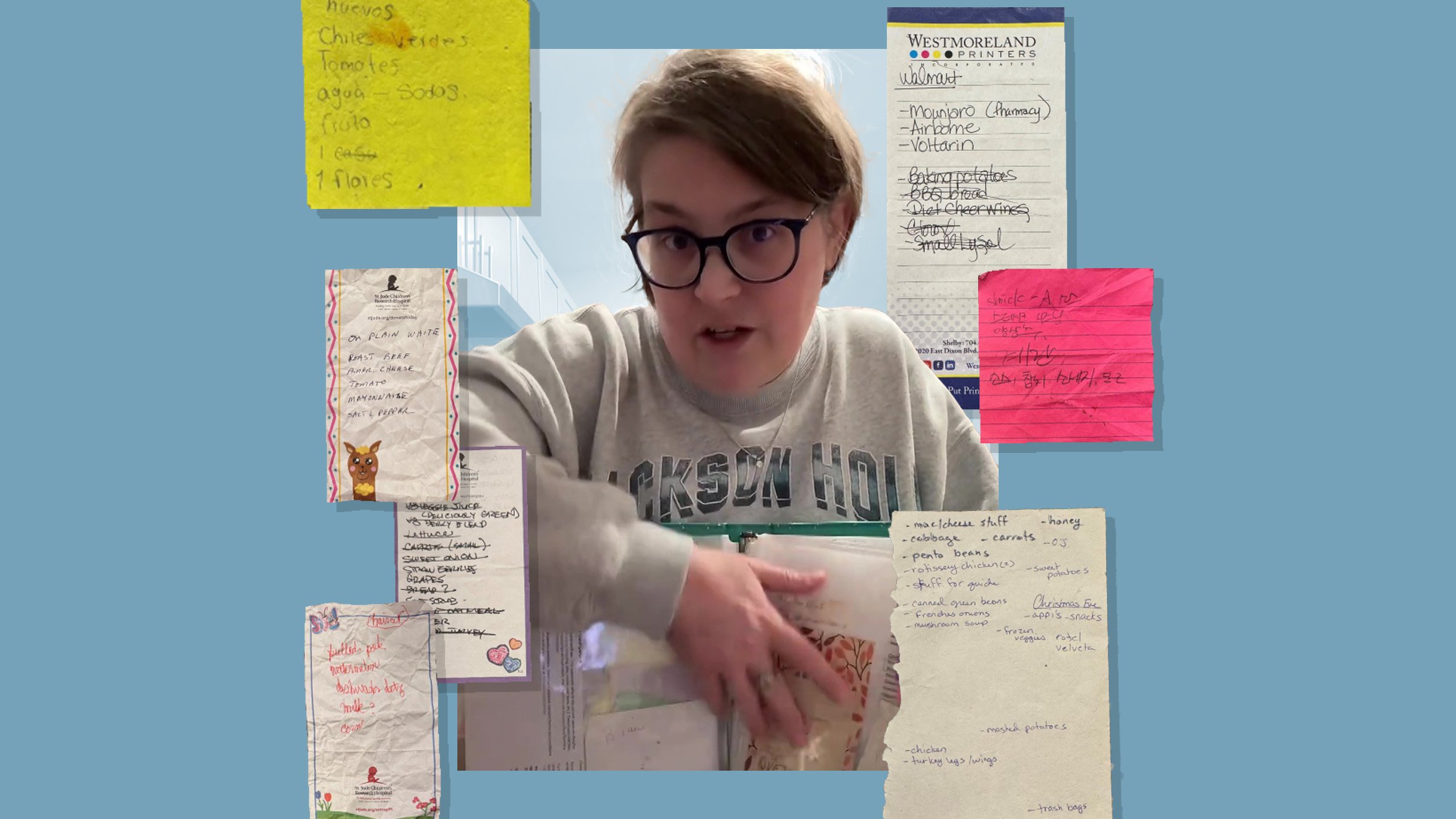
Now, six years later, Paige’s collection sits at more than 3,000. In different languages, scribbled on different bits of paper — all acting as windows into the lives of ordinary people in a rural state in the US.

‘I find grocery lists written on all kinds of surfaces’
The first list Paige ever found was a simple one, but it sparked something inside of her.
She shares: ‘I kept it initially because it made me laugh and I wanted to show my family. Based on the handwriting and the simplicity of the list, I imagined it belonged to an older man sent to the store by his wife for ingredients she needed for a chicken pot pie.’
A few days after her first find, Paige spotted another discarded list and she realised how many potential stories you could pull from something as ordinary as a shopping list.
From then, she started collecting them intentionally, plucking lists from car park floors, behind shopping trolleys, or even out of bins.

Paige has found lists written in several languages, including Korean,
Spanish, French, German, Hindi and Russian.
And on all kinds of surfaces too.
Hey, foodies! Add us as a Preferred Source
At Metro Food, we’re here to bring you all the latest foodie news, delicious recipes, restaurant reviews, and cooking tips. As a loyal reader and a part of our vibrant community, we want to make sure you never miss our articles when searching for stories
Click the button below and tick Metro.co.uk to ensure you see stories from us first in Google Search.

‘The most common are Post-it notes and scraps of paper, but some of my favorites are written on St. Jude Children’s Hospital notepads.
‘Those are often sent out as thank-you gifts when someone makes a donation to St. Jude in the US.
‘As a childhood cancer survivor, that cause is very close to my heart, so finding lists written on those notepads always feels especially meaningful.’

But while some might be meaningful, others can be straight up strange.
The weirdest grocery list Paige has ever found was written on the back of a police ticket for reckless driving.
Her favourite, however, is a list written on the back of a bank envelope that still contained a two-dollar bill.

‘I started seeing weight-loss medications right next to everyday groceries’
Paige will never know exactly who’s behind the lists she picks up, but she has been able to spot a few clear patterns and trends over time.
She explains: ‘I started collecting during COVID, and lists from that period
often included a lot more comfort items, sweets, chips, and alcohol showed up far more frequently than they do now.
‘But what’s especially interesting is how cultural trends show up. I can pinpoint when things like sriracha or Everything But the Bagel seasoning suddenly became popular because they start appearing on lists much more often, almost overnight.’

And it’s not just toppings that the public are after. Paige also notes how weight-loss medications like Wegovy, Zepbound, and Mounjaro have become a lot more common on the grocery lists she picks up.
For Paige, being able to watch and spot patterns like these is one of the reasons she finds her collection ‘so compelling’.
‘Grocery lists quietly document what people are worried about, excited about, or taking care of in that moment, they’re small but incredibly revealing snapshots of life.’
‘I’ve always been fascinated by people and their stories’
On top of her day job, Paige also makes content on social media, talking about her interests, showing off her thrift finds, and sampling interesting fruits.
And, as part of that journey, she also recently started sharing some of the lists she’s collected over the years with her audience.
Paige’s followers were amazed by her collection, with users commenting statements such as ‘you may be the most interesting person in the world’ and ‘there is something so beautifully human about this’. Others have pledged to sign off their future shopping lists ‘for Paige’.
But while some mind find Paige’s approach an anomaly, for her collecting these lists has felt like a ‘natural extension’ of her neurodivergence:
‘I’ve always been fascinated by people and their stories. Sitting in a restaurant, I’ll find myself wondering about the people at the table next to me, what they do for a living, whether they’re dating or siblings, what their hobbies might be.
‘My brain is constantly looking for patterns, details, and connections. Each list is a small puzzle. Who wrote it? Were they doing the shopping themselves or sending someone else? What are they planning to make with these ingredients? Do they live alone or have kids? How old
might they be? What do they do for a living?’

She then tries to answer these questions using context clues, focusing on things like the paper that was used, the handwriting and whether things are checked off or crossed out.
The most meaningful moment for Paige in this journey happened right after her grandmother passed away, when unexpectedly she came across one of her grocery lists while going through her belongings.
‘Seeing her handwriting again, something so ordinary and practical, was incredibly moving,’ Paige shares. ‘It wasn’t a letter or a keepsake she meant to leave behind, it was just a reminder to buy everyday items. But that’s exactly what made it so powerful.
‘It felt like a small, intimate glimpse into her daily life, frozen in time.
That experience changed the way I look at the entire collection. It reminded me that grocery lists aren’t just errands on paper, they’re evidence of care, routine, and presence. They show how people take care of themselves and others, and how even the most mundane details can become deeply meaningful once someone is gone’.