

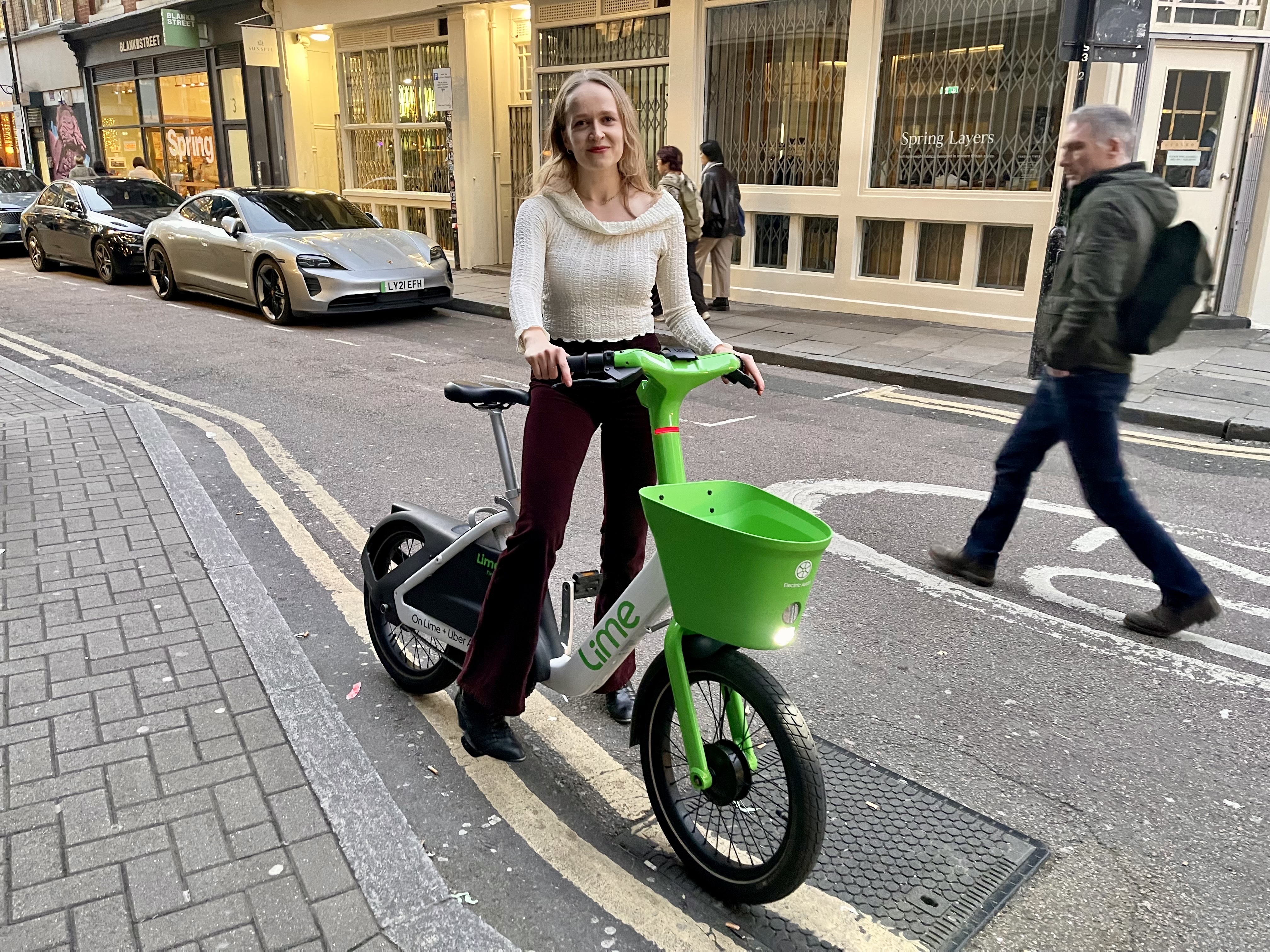
Let’s face it – love them or loathe them, you can’t deny the impact that Lime has had on London’s cycling scene.
The group, which is the biggest bike hire operator in London, has dominated the city’s streets with its bright green and white cycles.
And now it’s rolling out a new version – which hopes to tackle the current issues plaguing Londoners.
From later this month, cyclists in Oxford, Milton Keynes and the West Midlands will be able to try out their new snazzy cycles, while Londoners can snap them up from April.

But what is it like in action?
As someone who is still on the fence about rental e-bikes – largely because of obnoxious rider behaviour (not just during last year’s Tube strikes) – I approached the shiny, new bike with some reservations during its unveiling event in Shoreditch last night.
On first glance, I instantly thought of a Tesla when I saw the futuristic, smooth, second front light.
After hopping on and pedalling off, I noticed that they’ve fixed the sudden jolt that cyclists feel when you set off, making it smoother and easier to manoeuvre on London’s crowded roads. Could this tweak be the answer to the so-called ‘Lime leg’, where cyclists have had the bike fall on their leg when they slow down due to the weight of it?

Some of the other changes are so subtle I hardly noticed them, other than something just feels smoother – a telltale sign of thoughtful engineering.
The tricky silicone phone holder has been replaced with a sturdier card plastic case that, in theory, should be easier to use, but I struggled to stretch it far enough to fit my unnecessarily large phone without using both of my hands. Once the phone was in, it felt well-secured.
Whereas turning an older Lime around feels like being at the helm of a cargo ship, the new bike’s narrower handlebars made it more agile, enabling me to make a U-turn very easily on a busy road.
Latest London news
- Mum awarded £5,000 over ‘too small’ Cartier bracelet that Harrods refused to take back
- What I Own: We saved £40,000 in a year and bought our £440,000 London home
- Man went on frenzied knife attack during rush hour at London station
To get the latest news from the capital, visit Metro’s London news hub.


The new seat has a slight lean to it, giving the rider what feels like a lower position and more of a resemblance to riding a normal bike. Cycling over a large speed bumps felt sturdy even with the new, smaller tires that seem to pack a punch.
Adjusting the seat height with the new, horizontal lever was a dream compared to the old bike, often requiring Hulk-like strength, sweat and tears.
The step-through frame height has been lowered, making it easier to get on and off. I was assured by Lime that people of various sizes and ages tested the bike before it left the factory – a big plus in a world where too many things are still designed for the average man’s measurements.

A very London problem is struggling to find an e-bike when you really need to, while other pavements have turned into a jungle of badly parked bikes, leading to high-profile spats between e-bike providers and councils like Islington.
John Jenkins, Lime’s chief technology officer, told Metro that the new bikes are fitted with a parking display, showing the rider instantly whether or not they can park wherever they’ve stopped off, thanks to a new green and red display. Green means you can park there, red means you’ve got to scarper.
The bikes have also been upgraded with ‘much more accurate GPS inside,’ which is designed to help detect whether the bike is where it is meant to be.

When I asked him about the ‘Lime leg,’ John said he wasn’t too familiar with the concept but that all the bikes are designed to be ‘extremely safe’ and ‘99.9% trips end without any reported incident.’
So, am I a full Lime convert now?
Despite having just been wowed by the new versions, I instinctively picked up a non-electric Santander bike from the Shoreditch docking station, so make what you will of that.
But if I was able to hop on one of the new cycles tomorrow, would I do it?
Probably not, because it will never beat a traditional pedal bike.
What is different about the new LimeBike?
Here are the specs you can find on a new LimeBike:
- Display with icons showing whether the rider is in or outside a permitted parking zone
- Improved GPS accuracy showing a bike’s location within 1.5m
- Replaceable components to reduce waste, giving a bike an estimated life span of five years
- New phone holder
- Lower step-through height
- Second basket on bikes, which will be available on some bikes in Oxford and Milton Keynes only at first
- New battery position under the seat frame
- Smaller, 20-inch wheels
- Narrower handlebars, and comfort grips designed to be more comfortable on longer trips
Get in touch with our news team by emailing us at webnews@metro.co.uk.
For more stories like this, check our news page.