

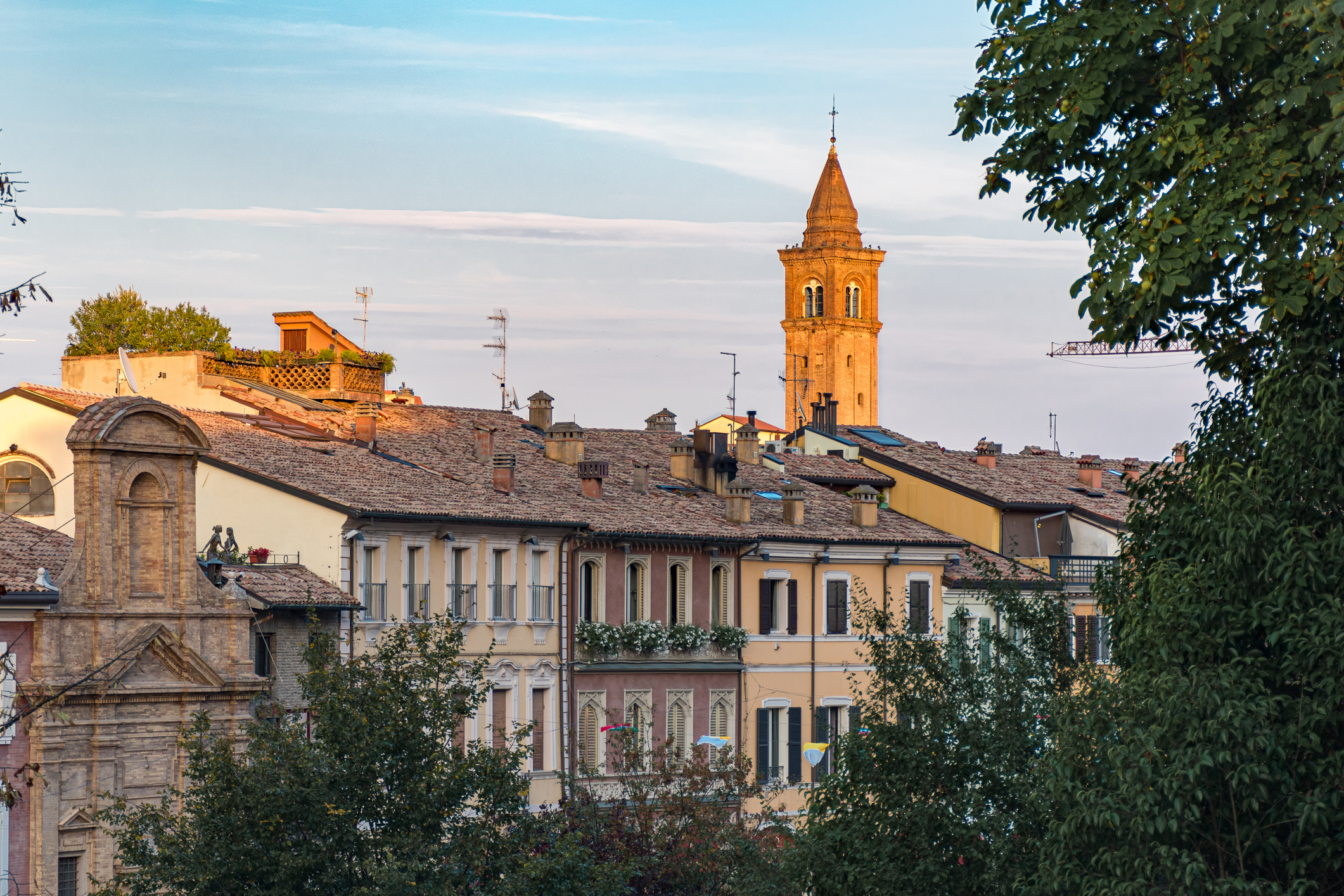

I’ve always considered it a great privilege that I’ve spent every summer in Italy since I was a little girl. I’m 27, and that magic still isn’t lost on me.
My stepmum is Italian, and because she’s been in my life since I was two, I’ve had the pleasure of growing up around the language, the food, and the culture of this inimitable country. For me, it’s the best in the world.
I’ve chatted to locals in Roman bars, floated on gondolas in Venice, enjoyed countless Aperitivos in Bologna, and taken in the preserved streets of Pompeii.
And while I’ve loved my trips to these famous destinations, I can’t name many cities I want to come back to again and again — apart from one.
Tucked away in the northern region of Emilia-Romagna, the little-known (to Brits, at least) city of Cesena is often overshadowed by its neighbour, Bologna — birthplace of bolognese.
But, to me, Cesena is more authentic and charming than anywhere in Italy, both in the height of the summer, when temperatures can get up to the high 30s, and in the depths of winter, when it’s not uncommon to see snow.
Just last year, I was lucky enough to visit not once, but twice, and I’ll be heading there in August 20206 too. So, here are my recommendations for exploring Cesena, also known as the City of Books.
Mortadella, Parmesan, and piadina
Win a restorative two-night staycation in Wales
We’re giving away a two-night B&B stay at top-rated Welsh hotel Albion Aberteifi in Cardigan, including cocktails for two at the hotel bar and a two-hour Nature Spa experience at fforest Farm (Welsh spelling, not typo), a short drive or a walk through a nature reserve.

For your chance to win this gorgeous spring getaway, enter your details into the form before midnight on Sunday, April 19. And don’t forget to sign up to The Getaway Expert, our seven-day guide to becoming a more confident traveller.
Full T&Cs apply, see here.
Cesena might not be as busy as Bologna, and it’s certainly not as touristy.
You’ll barely hear a word of English spoken on the streets, and if you do happen to be communicating in another language, you’ll get a (friendly) look from the locals, as if to say: ‘How did you come to visit our city?’

Undoubtedly, the number one reason to visit Cesena is for the food, which is unique from other parts of Italy.
The Emilia-Romagna region is famously foodie. It’s largely known for simple dishes done well, and making the most of the wealth of local resources thanks to its location close to both the sea and hills.
Some of the most popular foods to eat here include mortadella (a type of ham that’s been mimicked as ‘baloney’ elsewhere in the world), Parmesan, and piadina, a type of flatbread best enjoyed with something like squacquerone, a form of soft cheese that’s not hard enough to have a rind, but not mushy enough to be considered cottage cheese.

Wine drinkers should absolutely indulge in a glass of Sangiovese, a red that’s so embedded in the culture of the region that, in Romagnol (the regional dialect), it’s simply called ‘e be,’ which translates to ‘the drink.’
Though the north is a fairly wealthy part of Italy nowadays, it hasn’t always been this way – and so much of the population had to develop innovative methods of getting food on the table with what they had access to.
Take, for example, one of the region’s most beloved dishes, Strozzapreti (which literally translates to ‘priest stranglers’).

In Emilia-Romagna, this type of pasta – made by twisting fresh dough between the palms – is traditionally made from durum wheat, semolina flour, and water, although some more modern recipes incorporate egg whites and parmesan, breaking from the working-class roots.
If you want to try an authentic version of this beloved pasta dish, you’ll be able to find it on the menu at virtually every restaurant in Cesena.

If you want my recommendation, though, you’re best off trying Tre Papi, Osteria Michiletta, or La Stalla, which translates to ‘the stable,’ and references its history as a place for keeping horses.
In the world of desserts, the true magic of visiting Cesena is always found behind the counters of the Babbi Café.
Founded in 1952, it’s a local legend renowned for its chocolate spreads, wafers, and ice cream (which is served up all year round, not just during the summer). In Italy, seasons mean little when it comes to good food.

If you do pop in, you’ll thank me for picking up a pot of the pistachio spread, and there are jars and jars filled with their signature chocolate-coated wafer, to be enjoyed with an espresso after lunch.
Again, those with a sweet tooth will be appeased by Pasticceria Romagna. Just outside of the city centre, it’s the bakery responsible for cheffing up everyone’s traditional chocolate logs at Christmas (the ‘Tronco di Natale’), and even on December 25, there are long queues inundated with locals trying to get the dolce element of their Christmas lunch sorted.

Still, despite the slightly tedious wait, the staff are always in good spirits, ready to serve up bombolone (a breakfast food that’s essentially like a custard doughnut, but creamier) to the masses.
It’s sensational when paired with an indulgent latte macchiato (ideally enjoyed authentically, at the end of the bar), or simply an espresso for a quick shot of caffeine.
The city of books
Once you’ve filled your belly, Cesena has a rich history to absorb. It was referenced as early as Dante in 1321, who described the city centre as being ‘between the plain and the hills.’
It’s also home to the oldest public library in the world: the Malatestian Library, which holds such a fundamental place in Cesena’s constitution that it was designated a UNESCO World Heritage site in 2005.

It’s still the same as it was when it was built 600 years ago, and has only lost an impressive six books over the course of its lifetime, having survived the Napoleonic Wars. It holds 400,000 books, most of which are available for public consumption.
Catholicism runs through the veins of Italy’s history – and it comes as little surprise that two popes were from Cesena: Pius VI and Pius VII. As well as being fondly regarded as the City of Books (for its library connections), it’s also known as the City of Three Popes, the third being Pope Benedict XIII, who was a bishop there before his election in 1724.
So, whenever I arrive in Emilia-Romagna, I breathe a sigh of relief and let all the worries of London float away. No matter how long I stay here, I’m forever wishing I could extend my time. It’s always good to be home.
How to get to Cesena
The only downside to Cesena is that it doesn’t have an airport. You’ll need to get there from Bologna, Rimini (if you’re flying during the summer, that is; they pause routes in winter), or Forlì.
But this means that Cesena is a world away from the teeming waters of Venice and the overcrowded streets of Rome.

If you’re flying from London, the best option is to take a flight to Bologna Guglielmo Marconi Airport, which takes around 2 hours and 20 minutes. There are return options available in May for as little as £30 through Ryanair, departing from Stansted.
British Airways also flies from Heathrow, with May options coming in around £150.
During the summer, flying to Federico Fellini (which serves both Rimini and San Marino) is a slightly easier option. There are options through both easyJet and Ryanair, and a return ticket departing on July 15 currently costs between £115 and £138, respectively.
Plus, between June and October, Ryanair is reviving its route from London Stansted to Forlì, a quiet city of ancient churches and elegant piazzas that dates back 2,200 years. There are currently return flights, leaving on July 15, available for £78 a pop.
From Bologna, taking the train to Cesena takes just over an hour, while the quickest route from Rimini takes just 19 minutes. And, finally, Forlì is 27 minutes away from Cesena by car.
A version of this article was first published on December 27, 2025.
Do you have a story to share?
Get in touch by emailing MetroLifestyleTeam@Metro.co.uk.