

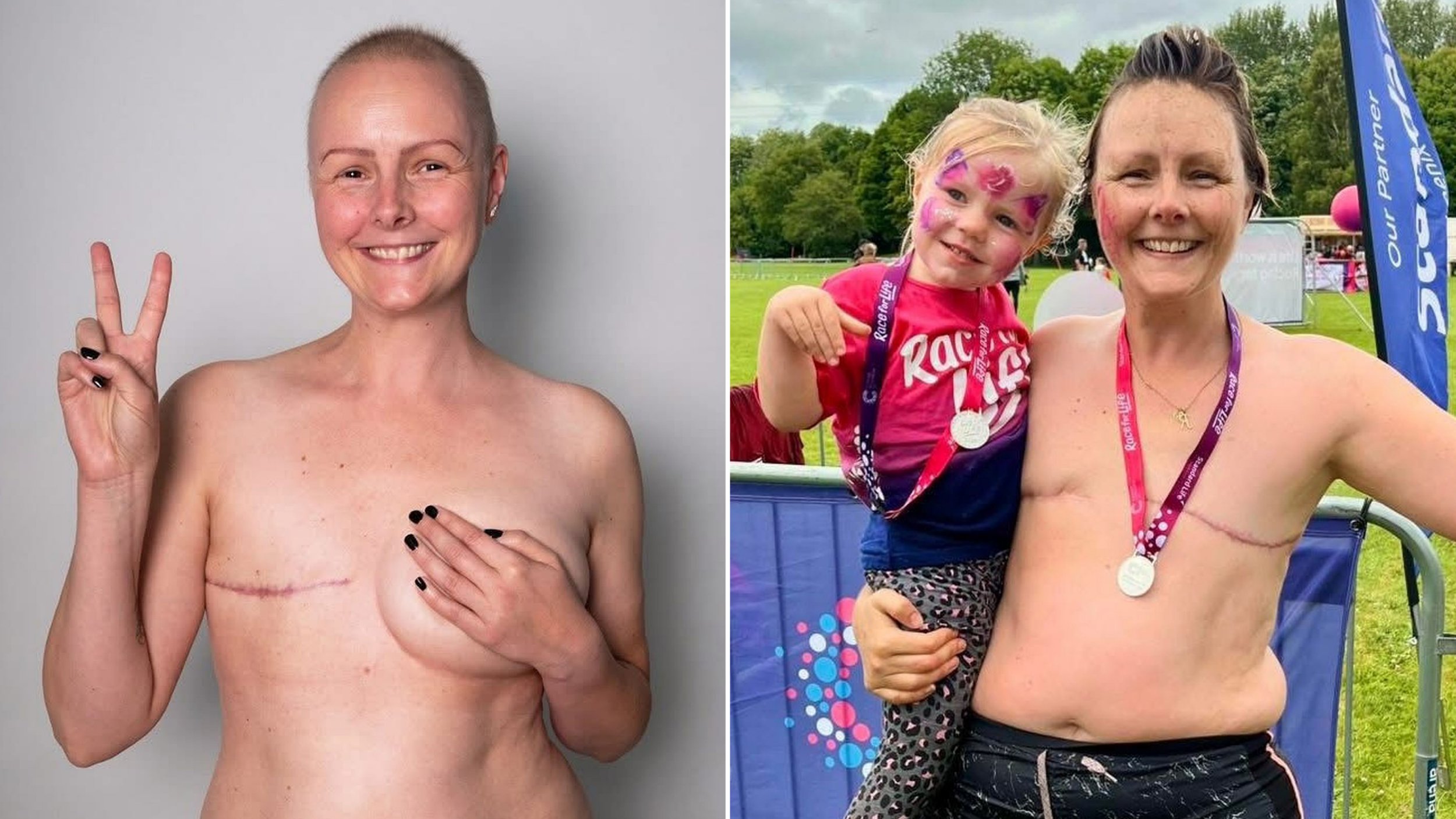

When Gemma Fish noticed that her right breast had begun to shrink, she assumed it was another side effect of pregnancy.
She gave birth to her daughter, Rosie, at the end of 2021, and over the next year, Gemma’s breast continued to reduce in size, eventually ending up three cup sizes smaller than her left.
It was when her nipple become inverted 14 months later, that Gemma, 43, decided it was time to visit the doctor.
On February 17 2023, the charity worker was diagnosed with breast cancer.
Gemma, a single mum, says she didn’t realise that breast shrinkage could be an indicator of a tumour.
She tells Metro: ‘I put it all down to pregnancy changes, it didn’t even enter my mind that it would be anything along those lines at all.

‘I purely just thought [a symptom of breast cancer] would be finding a lump and that it would be quite easy to find. I didn’t know that changes in breast size was a potential symptom’.
Enduring countless sessions of chemotherapy, radiotherapy, the removal of her ovaries, and two mastectomies, Gemma is now adjusting to living life with stage four cancer.
Emphasising how ‘it’s better to be safe than sorry’, she’s urging women to go and visit their GP if they notice any changes.
Explaining how her health journey began, the mum from Salford, Greater Manchester, shares: ‘Obviously in pregnancy, your body changes with every part of you’.
But as other things settled down, she noticed that one of her breasts was still quite large, while the other one was shrinking.
Describing them as ‘looking wonky’, Gemma adds: ‘My nipple started to turn inward and I was like “I really need to get this checked out”.

‘As soon as I went into the doctor’s appointment and explained everything I could tell by her face that it was serious’.
Gemma was initially diagnosed with stage one breast cancer, and informed that her right breast had shrunk to the size of the tumour that lingered beneath her skin.
‘It was just really, really surreal,’ she says.
‘I was like: “How the hell am I going to deal with this?”
‘I was thinking: “I’m a single mum, I just don’t have any ability to deal with the logistics of being poorly”.
‘At that point I wasn’t thinking: “I’m going to die from this”. I was more: “This is something that we have to deal with and get treated”.’
In March, four weeks after her diagnosis, Gemma had a single mastectomy on her right breast, quickly followed by an aggressive course of chemotherapy and radiotherapy.
And in January 2024, the single mum found out that her cancer was ‘oestrogen fed’, meaning she needed to have both of her ovaries removed.
After this surgery, the removed ovaries were tested for cancer cells. Tragically, it was discovered that there was signs of cancer in her ovaries, meaning the disease had spread, and was stage four.

This means that Gemma’s cancer is incurable, but she has faith in her treatment plan.
She says: ‘Living with stage four cancer is completely different now compared to how it was years ago. It’s no longer a straight death sentence so to speak, there’s lots of ladies that live long lives on various different treatment lines.
‘It was really hard initially to accept [my diagnosis], particularly being a single mum to Rosie.
‘There were lots of decisions and things I had to put in place for her future, shall I not be here.’
Now, almost three years on from when she first found out she had breast cancer, Gemma has had both her breasts removed, deciding not to go through reconstructive surgery.
She shares: ‘When I had the single mastectomy I just lived asymmetric. Since then I now just live flat chested, which was a massive adjustment’.
Gemma continues: ‘It was easier to live with one breast than to live with no breasts which sounds bizarre, but it was a massive mental toll getting used to my body again’.
How to check for signs of breast cancer
CoppaFeel! offers these simple steps on how to check your own chest for signs of cancer.
Look
- Look at your boobs, pecs or chest.
- Look at the area from your armpit, across and beneath your boobs, pecs or chest, and up to your collarbone.
Be aware of any changes in size, outline or shape and changes in skin such as puckering or dimpling.
Feel
- Feel each of your boobs, pecs or chest.
- Feel the area from your armpit, across and beneath your boobs, pecs or chest, and up to your collarbone.
Be aware of any changes in skin such as puckering or dimpling, or any lumps, bumps or skin thickening which are different from the opposite side.
Notice your nipples
- Look at each of your nipples.
Be aware of any nipple discharge that’s not milky, any bleeding from the nipple, any rash or crusting on or around your nipple area that doesn’t heal easily and any change in the position of your nipple
Her biggest goal now, for both herself and Rosie, is to live ‘as happily as we can and enjoy as many things as we can.
‘I think that’s the one thing that cancer teaches you is that our time is the most important thing in the world.
‘We should spend every minute, of every day, of every week, doing something that makes us happy because life can change in an instant so that’s what we do’.
Gemma is also urging other women to check their breasts, to spot cancer signs early.
‘If I had not ignored it and not buried my head in the sand it would have been caught a hell of a lot sooner,’ she says.
‘The whole treatment plan would have been completely different from what I’ve ended up doing, and possibly avoided it spreading’.
According to Cancer Research, there are 56,900 new cases of breast cancer each year in the UK.
An even more upsetting statistic is that a woman is diagnosed with breast cancer every 9 minutes and a man every day. And if nothing is done to change this, by 2040, charities have reported that a woman will be diagnosed every 8 minutes.
Do you have a story to share?
Get in touch by emailing MetroLifestyleTeam@Metro.co.uk.