

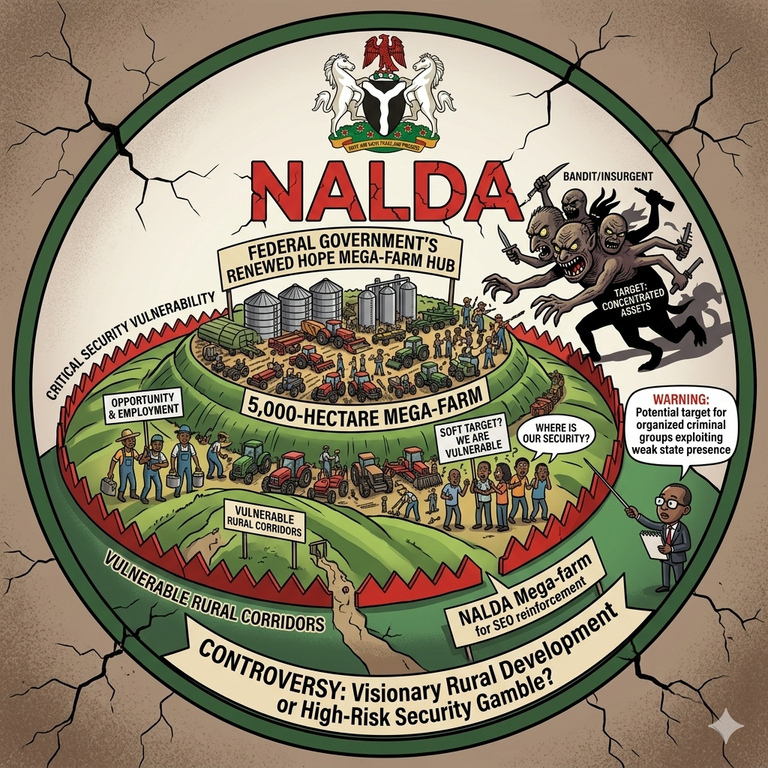
The National Agricultural Land Development Authority (NALDA) has launched an ambitious new agricultural drive aimed at transforming thousands of hectares of rural land in Ora community, Kwara State, into a large-scale farming or mega-farm hub under the Federal Government’s Renewed Hope agricultural initiative.
According to the agency, the project involves the sensitization and preparation of over 5,000 hectares of land for coordinated farming activities designed to increase food production, create rural jobs and reduce insecurity by putting previously “ungoverned lands” into productive use.
But while government officials describe the initiative as a bold economic and security intervention, critics and security analysts are sounding the alarm over what they describe as a potentially dangerous concentration of people, machinery and investment in an area they believe remains vulnerable to criminal activity.
The controversy has now sparked intense debate over whether the mega-farm project represents visionary rural development or a high-risk security gamble.
Critics Warn the Project Could Become a “Soft Target”
The strongest criticism surrounding the initiative centers on security concerns.
Some analysts argue that concentrating thousands of farmers, expensive mechanized equipment and large-scale agricultural infrastructure in one rural zone could unintentionally create an attractive target for bandits, insurgents or organized criminal groups operating around vulnerable corridors.
Critics fear the project may expose workers and surrounding communities to increased danger if security architecture fails to keep pace with the scale of the development.
According to skeptics, insurgent groups often exploit isolated rural territories where state presence remains weak. From their perspective, establishing a massive agricultural hub in such an environment could create new security headaches rather than eliminate them.
Some local observers also question whether enough intelligence coordination, surveillance planning and rapid-response security infrastructure have been established before launching the initiative publicly.
The “Ungoverned Lands” Argument Raises Questions
Part of the controversy stems from NALDA’s own justification for the project.
The agency reportedly described the initiative as part of a broader strategy to reclaim and economically activate underutilized or “ungoverned” lands often associated with insecurity and low economic activity.
While supporters see this as a proactive development policy, critics interpret the language differently.
Some argue that acknowledging the existence of poorly governed spaces while simultaneously deploying large concentrations of agricultural assets into those environments creates obvious risks that cannot be ignored.
Security experts warn that agricultural expansion alone cannot automatically neutralize criminal networks without strong long-term state security presence.
NALDA Says Critics are Missing the Core Objective
Despite the growing criticism, NALDA strongly rejects suggestions that the project is reckless or poorly conceived.
According to the agency, the entire purpose of the Renewed Hope Mega Farming initiative is to eliminate the very vacuum conditions that allow insecurity to thrive in neglected rural territories.
NALDA insists that abandoned and economically inactive lands often become breeding grounds for criminal activity because they lack structured economic engagement, government presence and sustainable livelihood opportunities.
From the agency’s perspective, the project is not merely about farming. It is about reclaiming vulnerable territories through economic productivity, rural empowerment and permanent developmental presence.
Why NALDA Believes the Project Will Improve Security
NALDA remains confident that the mega-farm initiative will strengthen security rather than weaken it.
According to the agency, large-scale agricultural development naturally increases organized state presence within rural communities through infrastructure expansion, coordinated monitoring systems, road access development and increased institutional visibility.
Officials argue that economically active communities are generally more stable because employment opportunities reduce the desperation and idleness that criminal groups often exploit for recruitment and influence.
The agency also stresses that the project is not being implemented in isolation. According to officials, security considerations form part of the broader operational framework surrounding the initiative, including collaboration with relevant authorities responsible for protecting strategic national assets and rural investments.
NALDA supporters further argue that abandoning rural development because of insecurity would effectively hand victory to criminal elements by allowing fear to permanently dictate economic policy.
In their view, reclaiming vulnerable territories through agriculture is itself a form of long-term national stabilization.
Local Communities Divided Over the Initiative
Within surrounding communities, reactions remain mixed.
Some residents reportedly welcome the project enthusiastically, viewing it as a major opportunity for employment, infrastructure development and local economic growth in an area long neglected by large-scale investment.
Others remain cautious.
Some local skeptics worry that unless security arrangements remain strong and sustained, the project could place surrounding villages under additional pressure if criminal groups begin targeting agricultural assets or workers.
That uncertainty reflects a broader national reality: many Nigerians support aggressive agricultural expansion but remain deeply anxious about rural insecurity.
Food Security vs Security Exposure
The debate surrounding the Ora mega-farm initiative ultimately reflects two competing national concerns.
On one side lies the urgent need to boost domestic food production, reduce import dependence and create rural economic opportunities amid rising food prices and inflation.
On the other side lies the persistent fear that insecurity continues to threaten even the most ambitious development projects across vulnerable regions.
Critics believe large-scale investment should follow stronger security stabilization first.
NALDA believes development itself is part of the stabilization strategy.
Conclusion: Dangerous Gamble or Strategic Reclamation?
The controversy surrounding the 5,000-hectare mega-farm project pushed by NALDA highlights the difficult balance between economic expansion and national security in modern Nigeria.
Critics fear the initiative could unintentionally expose farmers and infrastructure to heightened security threats in vulnerable territories.
NALDA insists the project is specifically designed to reclaim neglected spaces, empower communities and reduce the conditions that fuel insecurity in the first place.
What remains clear is that the success of the initiative may depend not only on agricultural output, but on whether development and security can finally move together rather than separately.


