

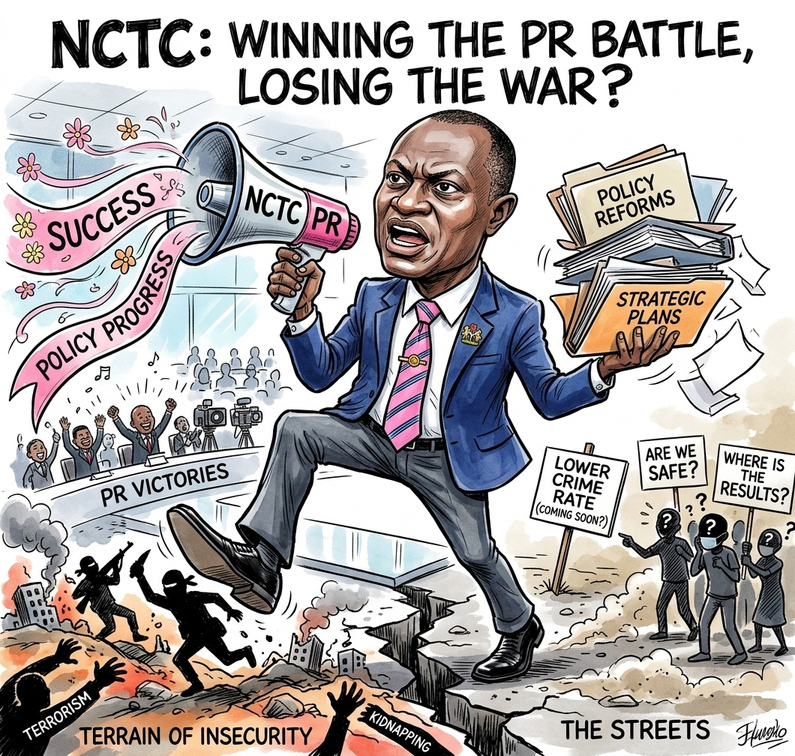
A provocative criticism is gaining traction in security circles: Is Nigeria’s counter-terrorism establishment, NCTC, winning public relations (PR) battles while struggling on the battlefield of insecurity?
At the center of the debate is the praise the agency receives regarding policy circles for strategic communication, partnerships and high-level coordination, but criticized by some observers who say glossy reports and diplomatic forums cannot substitute for safety in vulnerable communities.
The accusation is blunt:
- Too much public relations.
- Not enough pressure on armed groups.
But does the criticism hold?
The Charge: Winning the Narrative with PR, Losing Against Insecurity
Critics point to a growing emphasis on:
- Strategic communication campaigns
- Counter-terror publications and policy messaging
- International partnerships and conferences
- Public briefings around reforms and cooperation
They argue these efforts create the image of momentum while insecurity in some areas remains deeply concerning.
Recent deadly incidents, including scrutiny after a military strike that reportedly killed civilians, have sharpened those concerns.
To critics, the question is simple: Are institutions communicating success faster than security is improving?
Why the “PR War” Label Against NCTC Sticks
The NCTC has visibly expanded its strategic communication footprint.
Its Strategic Plan 2025–2030 emphasizes not only hard security but also counter-narratives, public trust, intelligence integration and non-kinetic responses.
Supporters call that modern counter-terrorism. Critics call it branding. That divide fuels the controversy.
NCTC Responds: Counter-Terrorism is More Than Gun Battles
Security experts push back strongly against the criticism. They argue it misunderstands modern counter-terror strategy. Today’s counter-terrorism is not only about raids and arrests.
It also involves:
- Preventing recruitment
- Countering extremist propaganda
- Tracking terrorist financing
- Cross-border intelligence cooperation
- Community resilience building
In that model, communication is not a distraction. It is part of the fight.
NITDA Says Communication and PR are Tools Against Insecurity
Officials argue that what critics call “PR” is often strategic communication used to weaken extremist narratives.
And evidence supports that this is embedded in the current doctrine.
Recent NCTC messaging has also highlighted:
- Terror financing disruptions
- Hundreds of terrorism-related convictions
- Expanded technology-driven intelligence coordination
- International counter-terror partnerships
Supporters say those are not magazine covers. Those are operational indicators.
Why the Streets Still Feel Unconvinced
Yet public skepticism persists for a reason. For citizens facing attacks, kidnappings or instability, success is measured differently.
Not by strategy documents. By whether communities feel safer. That gap between policy metrics and public experience drives much of the criticism.
Kinetic vs Non-Kinetic: A False Choice?
Some analysts say the debate is built on a false choice.
As if Nigeria must choose between:
- Guns or intelligence
- Operations or communication
- Force or prevention
Modern security strategy says it requires both. And many argue NCTC has leaned into that combined approach.
The Bigger Security Problem
Critics sometimes place burdens on the NCTC that extend beyond its mandate. Many drivers of insecurity involve:
- Border vulnerabilities
- Illegal arms flows
- Economic pressures
- Local governance failures
- Regional militant movements
No single counter-terror institution can solve those alone. That complicates simplistic “winning or failing” narratives.
Optics Matter — But So Do Results
Critics are not wrong to question outcomes. Accountability matters. But supporters argue that dismissing strategic communication as mere PR ignores a major lesson in counterinsurgency:
- Narratives can be battlefields too.
- Winning legitimacy often matters alongside winning territory.
A More Difficult Truth
Perhaps the sharper truth is not that NCTC is losing the streets. It is that the streets remain contested. And in such environments, progress can look incomplete even when real gains exist. That tension fuels both criticism and defense.
Conclusion: PR Machine or Evolving Security Strategy?
Critics argue that communication cannot replace security outcomes. NCTC argues that communication is part of those outcomes.
Both arguments carry weight. The deeper question may not be whether NCTC is winning PR or losing streets. It may be whether Nigeria can align visible security results with strategic reforms quickly enough to sustain public trust.