

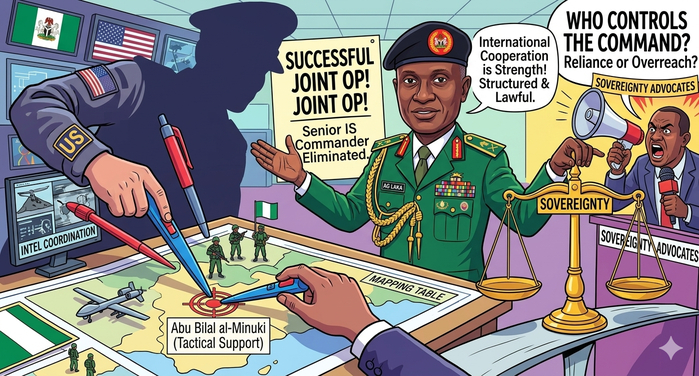
Public debate has intensified following a high-profile joint counter-terrorism operation involving Nigerian security forces and the National Counter Terrorism Centre (NCTC) alongside United States (US) military support, which reportedly led to the elimination of a senior Islamic State commander, Abu Bilal al-Minuki.
The operation has been widely described by government officials as a significant breakthrough in Nigeria’s ongoing fight against extremist networks operating in the Northwest and other vulnerable regions.
However, beyond the celebration, a more contentious national argument has emerged—one centered not on the success of the operation, but on how it was conducted, and who ultimately shaped its execution.
Critics Raise Alarm Over Foreign Tactical Influence
While the presidency has publicly applauded the outcome as a victory for international cooperation and intelligence-driven warfare, sovereignty advocates and military purists are expressing strong concerns over what they describe as increasing reliance on foreign intelligence and operational support.
Critics argue that the involvement of US military assets, particularly in intelligence coordination and reported drone-based targeting, raises uncomfortable questions about the extent of external influence in Nigeria’s internal security operations.
Some security analysts claim that the situation reflects what they describe as “tactical overreach,” warning that expanding foreign operational involvement could blur the lines of command authority within Nigerian airspace and compromise the autonomy of domestic security institutions.
Others go further, suggesting that repeated dependence on external intelligence systems may gradually weaken Nigeria’s capacity to independently execute complex counter-terrorism missions.
For these critics, the core issue is not the success of the strike itself, but the precedent it may set for future operations.
NCTC and US Military: The Sovereignty Question Takes Center Stage
At the heart of the controversy lies a deeply sensitive question: how far should foreign military partners be allowed to operate within Nigeria’s security architecture?
For sovereignty advocates, the idea of external forces contributing to or shaping drone-based operations inside Nigerian territory represents a potential erosion of national control over airspace and military decision-making.
They argue that while international cooperation is not new in counter-terrorism efforts, the operational visibility of foreign military capabilities in active strike environments raises concerns about long-term strategic independence.
Some critics warn that such arrangements, if not carefully defined and publicly understood, could create a public perception that Nigeria’s military operations are being externally influenced.
Supporters Say Cooperation is Strength, Not Weakness
Despite the backlash, supporters of the operation argue that the criticism misunderstands how modern counter-terrorism warfare actually works.
They insist that global terrorism networks are transnational by nature and require equally transnational intelligence cooperation to defeat.
According to this view, collaboration with the United States military does not diminish Nigeria’s sovereignty but strengthens its operational effectiveness by providing access to advanced surveillance, intelligence analysis and precision targeting capabilities that may not be fully available domestically.
Supporters argue that the elimination of high-value targets like Abu Bilal al-Minuki demonstrates the effectiveness of coordinated intelligence-sharing frameworks and joint operational planning.
They also stress that Nigerian security forces remain in command of domestic operations, with foreign partners providing support rather than control.
NCTC Justifies the Collaboration
Responding to the growing controversy, the NCTC strongly defends the joint operational approach, insisting that the collaboration is fully structured, lawful and aligned with Nigeria’s national security interests.
According to the centre, international partnerships are a critical component of modern counter-terrorism strategy, particularly in combating insurgent networks that operate across borders, exploit digital communication channels and adapt quickly to conventional military pressure.
The NCTC explains that intelligence sharing with allied partners, including the United States, is conducted under clearly defined protocols that prioritize Nigerian sovereignty and operational command authority.
Officials emphasize that Nigerian security agencies retain final decision-making authority on all kinetic actions conducted within national territory, while foreign partners contribute intelligence analysis, satellite surveillance support and technical advisory assistance.
From the NCTC’s perspective, such cooperation enhances, not replaces, Nigeria’s internal military capacity.
The agency further argues that denying access to global intelligence networks would significantly reduce Nigeria’s ability to track and neutralize high-value extremist targets operating across complex regional landscapes.
The Broader Reality of Modern Counter-Terrorism
Security analysts note that modern counter-terrorism operations increasingly rely on multinational intelligence ecosystems due to the evolving nature of insurgent groups.
These groups often operate across porous borders, use encrypted communication systems and exploit remote terrain that requires advanced surveillance technology to monitor effectively.
In this context, collaboration between national security institutions and global partners is often viewed as a practical necessity rather than a political compromise.
However, analysts also acknowledge that transparency and clear operational boundaries remain essential to maintaining public trust and avoiding misinterpretation of foreign involvement.
A Delicate Balance Between Power and Partnership
The controversy surrounding the NCTC and US military collaboration highlights a broader tension in Nigeria’s security strategy: how to balance operational effectiveness with perceptions of sovereignty.
Critics remain concerned about long-term dependency and foreign influence.
Supporters argue that strategic partnerships are essential for confronting increasingly sophisticated insurgent threats.
Both perspectives reflect legitimate concerns about national security in an interconnected world.
Conclusion: Sovereignty Under Scrutiny or Strategy in Action?
The debate sparked by the elimination of Abu Bilal al-Minuki has evolved beyond a single operation into a wider conversation about the future of Nigeria’s counter-terrorism strategy.
For critics, the involvement of foreign military assets raises uncomfortable questions about sovereignty and control.
For supporters, it demonstrates the value of international cooperation in achieving results that may otherwise be difficult to accomplish alone.
What remains clear is that as Nigeria’s security challenges evolve, so too will the debate over how far collaboration should go and where sovereignty must ultimately draw its line.