

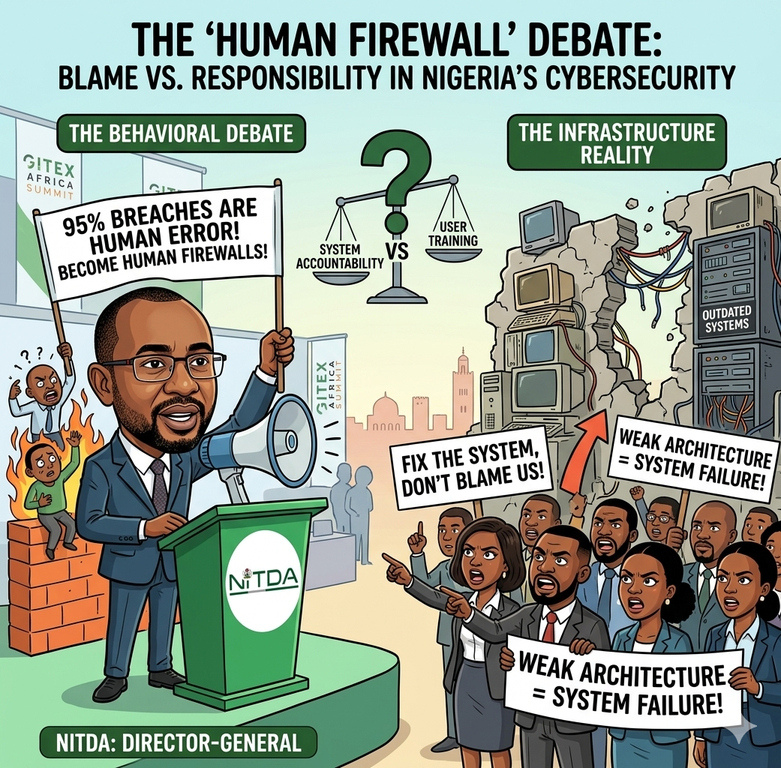
A heated digital policy debate has erupted after comments made at the GITEX Africa summit by the Director-General of the National Information Technology Development Agency (NITDA) suggested that as much as 95% of cyber breaches originate from simple human mistakes.
The statement, intended to emphasize digital awareness, has instead triggered a wave of criticism across Nigeria’s tech ecosystem, with advocates arguing that the agency is shifting responsibility for systemic cyber failures onto ordinary citizens.
What was meant as a cybersecurity awareness message has quickly turned into a national argument about accountability, infrastructure, and digital literacy.
The “Human Firewall” Strategy and Its Critics
In his remarks, the NITDA leadership emphasized the need for Nigerians to become “human firewalls,” arguing that improved awareness and user behavior remain the strongest defense against cyberattacks targeting government and private digital systems.
However, this framing has not been well received by many tech professionals.
Consumer rights groups and cybersecurity analysts argue that while human error contributes to breaches globally, Nigeria’s cyber vulnerability cannot be reduced to user mistakes alone. They insist that weak infrastructure, outdated systems, poor security architecture, and inconsistent enforcement of digital regulations also play major roles.
Critics say the “human firewall” narrative oversimplifies a complex problem and risks placing disproportionate responsibility on citizens who often lack adequate digital training.
Accusations of Deflecting Systemic Responsibility
Backlash intensified as critics accused NITDA of attempting to shift attention away from deeper structural issues affecting Nigeria’s cybersecurity landscape.
Some argue that focusing heavily on user behavior allows institutions to avoid difficult conversations about system vulnerabilities, procurement gaps, software weaknesses, and insufficient investment in cyber defense infrastructure.
From this perspective, the statement is not just technical but political.
Advocacy groups say the real issue lies in the security architecture of public digital systems, many of which handle sensitive data and high-volume transactions but may not always meet global cybersecurity standards.
They argue that blaming users alone risks ignoring institutional responsibility to build secure-by-design systems.
What NITDA Actually Meant, According to Supporters
Supporters of the agency have defended the statement, arguing that it has been misunderstood and taken out of context.
They say the core message is not about blame but about awareness.
According to this view, even the most advanced cybersecurity systems can be compromised if users fall for phishing attacks, use weak passwords, ignore security updates, or share sensitive credentials carelessly.
Supporters insist that Nigeria’s digital transformation agenda requires both strong infrastructure and informed users. In their view, the “human firewall” concept aligns with global cybersecurity education standards, which emphasize that human behavior is often the weakest link in security systems.
The Bigger Debate: Infrastructure vs Behavior
The controversy has now evolved into a broader policy debate about where responsibility truly lies in cybersecurity governance.
Tech experts argue that focusing too much on users risks shifting attention away from systemic investment in secure government digital platforms, threat monitoring systems, incident response capacity, and national cybersecurity frameworks.
They stress that while human error is real, it cannot substitute for robust infrastructure.
On the other side, policymakers and institutional defenders argue that no system can be fully secure if users continuously bypass basic security practices.
This tension is now at the center of the dispute.
Why the Reaction was So Intense
The reaction to NITDA’s statement reflects a growing sensitivity in Nigeria’s digital space.
As more government services move online, citizens are increasingly exposed to cybersecurity risks ranging from identity theft to financial fraud and data breaches. That exposure has made digital trust a critical national issue.
So when a major agency suggests that users are responsible for most breaches, it triggers anxiety among citizens who already feel vulnerable in the digital ecosystem.
Critics argue that public messaging must carefully balance awareness with accountability to avoid eroding trust.
Cybersecurity Awareness or Accountability Shift?
The core disagreement is not whether human error exists, but how responsibility should be framed.
Critics believe the messaging risks turning citizens into scapegoats for broader institutional weaknesses.
Supporters believe it is a necessary wake-up call in a country still developing strong digital habits.
Both positions reflect legitimate concerns, but they interpret the same statement in fundamentally different ways.
On Cyber Breaches: Who Protects the Digital System?
The controversy surrounding NITDA’s “human firewall” message has revealed a deeper national question.
Is cybersecurity in Nigeria primarily a technological responsibility, or a shared behavioral one?
For critics, institutions must fix systems before blaming users. For supporters, security is shared responsibility and systems are only as strong as the people who use them.
What is certain is that as Nigeria expands its digital infrastructure, the debate over who is responsible for protecting it will only grow more intense.