

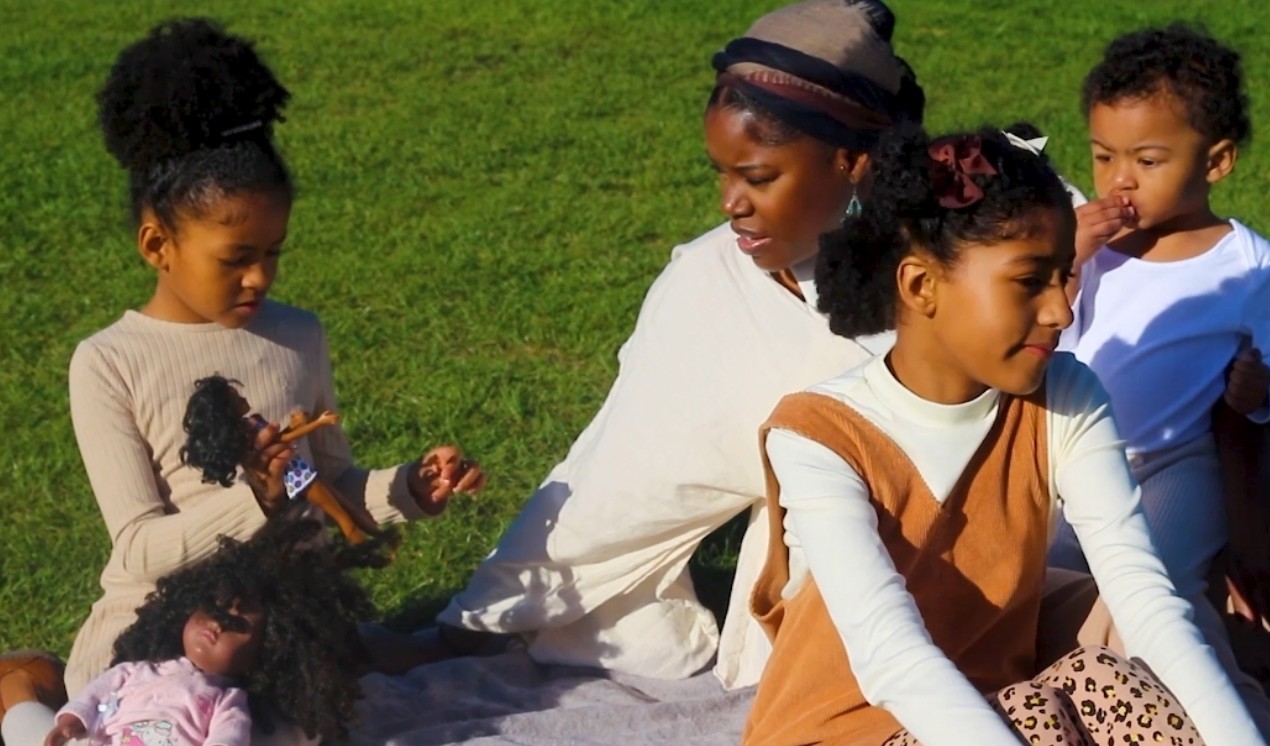

‘As a mother of Black, disabled children, you don’t often want to speak about your experience,’ admits mum-of-three Marsha Martin.
‘About the fact that your child smeared poo up the wall this morning, or that you don’t know how to do their hair because they have sensory processing disorder.
‘You don’t want to talk about how they tell you it feels like razor blades scraping at their forehead when you brush it – but because they have an afro, it’s not as simple as just comb it through and move on.’
The 37-year-old’s two eldest daughters, aged 13 and eight, have both been diagnosed with ASD (Autism Spectrum Disorder) and ADHD, while her youngest, who is nearly four, is just starting the diagnostic pathway.
‘One of the biggest signs of her autism is that she was non-speaking until she turned three – then she started talking in full sentences,’ Marsha explains to Metro.

Finding a community
Having qualified as a behavioural therapist in 2014, Marsha knew how important it was to have support in place for children with special educational needs (SEN).
‘Learning about autism theoretically, in the books, is one thing. But having it as a lived experience and being a mother of a child who is autistic – it’s completely different,’ she says.
Following her eldest daughter’s diagnosis in 2017, Marsha joined a group for mums and their neurodivergent children in the outskirts of London. However, she was often left feeling like an outsider.
‘I was living in a predominantly non-Black area at this time,’ she explains. ‘There would be comments about my daughters hair, our skin colour, the other mums would exclude us from conversations and ignore us.
‘It got to the point that when I spoke to some groups of people standing around, they would just pretend they didn’t hear me. I’m originally from Hackney, which is very multicultural and diverse, so I hadn’t really experienced racism up until this point.’

Eventually Marsha decided to leave the group ‘for her sanity’, but then discovered there was nowhere suitable for her to take her daughter for specialised support – and no one to talk to about what they were going through.
Creating a safe space
‘I didn’t feel like I had anyone surrounding me that I could relate to – or could relate to me – in terms of lived experience,’ remembers Marsha.
So, in 2019, she created her own support network – an online group called Black SEN Mamas on Instagram.
‘I didn’t expect much of it, I just wanted to find people with similar lived experiences to me, but in the first couple of months, we had a few hundred members,’ she remembers.
‘I think that probably speaks to the fact that there wasn’t anything like this out there. A space was sorely needed for those within that particular intersection of race and disability whereby we are a minority within a minority, being Black and disabled.

‘There are a whole load of systemic barriers that we’re having to navigate alongside trying to access quality support and healthcare like everyone else,’ Marsha explains.
‘Statistics show there is a disparity for neurodivergent people accessing healthcare, and being Black, you’re also part of another community who struggle for access.
‘I needed a space where I could speak about this openly, and not feel like I had to moderate my thoughts or filter what I was feeling. There aren’t many spaces where Black women are allowed to be vulnerable, and that hinders healing.’

Cultural understanding
As the group grew, Marsha discovered just how vital it was to have a safe place for mothers to open up about cultural issues, too.
‘There are things Black mamas can feel hesitant talking about when we’re not in Black company, for fear of judgement,’ she explains.
‘However, these mums could finally speak out about culturally embedded taboos, like their children being accused of having black magic, or voodoo on them, by their own community.’
In 2020, Marsha launched Black SEN Mamas as an official charity. The group now has over 7000 members and has been shortlisted for Community Group of the Year at this year’s Scope Awards, which Metro is proud to partner.

‘Scope recognising the efforts of Black SEN Mamas is amazing for us,’ says Marsha. ‘It’s not so much for me, but for the light shined on the work that we do, because it means more people can find us. We can grow as a community.’
While the group has been welcomed by most, there have been some challenging moments, admits Marsha.
‘I got a message the other day from a disgruntled white lady, who told me the name of the group was really selfish, because it has Black in the title,’ she says.
‘She asked how I would feel if I saw a ‘White SEN Mamas’. I replied that I’ve been to groups that don’t explicitly have that name, but it was not a safe space for me and my children.
‘At Back SEN Mamas, everyone is welcome. I know too well what exclusion feels like, we just prioritise Black mums knowing this is a safe space for them.’
The mental toll
And it’s not just about supporting children – being there for mothers is just as important, adds Marsha, who has also been diagnosed with autism.

‘Black women are the least likely demographic to seek out interventional support for mental health. After a lifetime of masking and putting our needs on the backburner, it takes a toll on your mental wellbeing.
‘Mums are sectioned, or even worse. Children are then left in the care system and a lot of them are very vulnerable. That’s why a lot of the work we also do is in suicide prevention.’
Last year, Marsha set up the Black SEN Mamas parliamentary steering group and is currently a co-campaigner on the ‘Save Our Children’s Rights’ (SOCR) campaign, along with IPSEA (Independent Adviser of Special Education Advice) and other organisations such as Special Needs Jungle, a non-profit information hub for parents of neurodivergent children.
‘I was a special educational needs professional, so I had access to resources, information and knowledge that lay-mums didn’t,’ she explains. ‘The local authorities should be giving parents like me all the information on the statutory system, but they don’t.’

Following a white paper released by the government last month outlining controversial SEND reforms, many members of Black SEN Mamas have ‘turned up in troves’ to support the campaign, which is drafting a response to the white paper.
‘That’s why it’s important to have groups like mine,’ says Marsha. ‘We have a group of specialists, we have a census, we have solicitors and lawyers, therapists, social workers, doctors.
‘They’re a team of Black mothers with neurodivergent children, they know their stuff. Parents like myself should be leading the conversations on SEND Reform – 7000 people is a lot of political power.’