

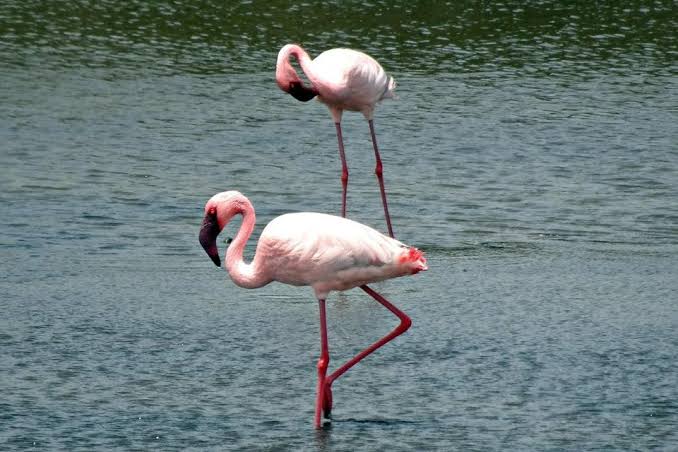
Raw sewage pollution has rendered Kamfers Dam, once a vital breeding ground for lesser flamingos in South Africa, uninhabitable, leading to the abandonment of the site by the iconic pink birds, according to conservationists and a court judgment.
Until recently, the lesser flamingo, classified as near-threatened, had four African breeding sites: two salt pans in Botswana and Namibia, a soda lake in Tanzania, and Kamfers Dam. Now, only three remain.
Years of untreated sewage spills have made the water in Kamfers Dam so toxic that the flamingos, which once congregated there in large numbers to breed, have disappeared, according to conservationists and a court order against the local council obtained by Reuters.
The loss of Kamfers Dam, the only South African water body where lesser flamingos bred in significant numbers, has exacerbated the decline of the species. While the International Union for Conservation of Nature (IUCN) currently classifies lesser flamingos as near-threatened, with an estimated population of 2-3 million, their numbers are dwindling rapidly.
Conservation biologist Tania Anderson told Reuters that the IUCN is preparing to upgrade the flamingo’s threat level to “vulnerable,” indicating a high risk of extinction in the wild. This reclassification is largely due to the shrinking availability of their preferred habitats: shallow, salty estuaries and soda lakes.
“It’s really very upsetting,” Anderson said, referring to the sewage spills at Kamfers Dam. “Flamingos play a pivotal role in maintaining the water ecosystems of our wetlands.”
A 2021 study in Biological Conservation highlighted the widespread threat posed by sewage to aquatic ecosystems globally. Despite a commitment from 200 nations at the U.N. COP16 biodiversity summit to address threats to wildlife, no agreement was reached.
“They Just Disappeared”
Footage from May 2020 shows Kamfers Dam teeming with flamingos, its waters turned a vibrant pink. However, a recent visit by Reuters revealed a starkly different scene: a green sludge, bubbling and reeking of human waste, with no flamingos in sight.
“It was a sea of pink,” recalled Brenda Booth, who owns a farm overlooking the lake. “They all just disappeared.” Booth recently secured a court order compelling the African National Congress (ANC)-run municipality in charge of Kimberley to address the pollution issue.
According to Adrian Horwitz, the lawyer representing Booth in the High Court, the treatment plant “became progressively dysfunctional to the point where … approximately 36 megalitres a day of untreated sewage was being discharged into the dam.”
Municipality manager Thapelo Matlala attributed the plant’s failure to vandalism and theft, stating that the council lacks the 106 million rand ($5.92 million) needed for repairs.
The ANC’s failure to provide basic services was a key factor in its loss of a 30-year majority in recent elections.
Lesser flamingos primarily feed on spirulina, a blue-green algae, which they filter through their beaks. This dietary preference restricts them to alkaline water bodies, mainly in East Africa’s Rift Valley.
The birds are highly selective about their breeding sites, with only three locations in India and three remaining in Africa.
Read more: Ukraine Faces Gas Shortage as Storage Facilities Dwindle
Flamingos began breeding at Kamfers Dam in 2006, according to Ester van der Westhuizen-Coetzer, a wetlands specialist for local diamond miner Ekapa Group. In 2020, the dam hosted 71,000 flamingos, with up to 5,000 new chicks each season.
“They’ve missed three or four breeding seasons,” she said, adding that many birds also died from botulism, a disease that thrives in polluted water.
Sewage pollution is a widespread problem in South Africa, where few treatment plants are functioning properly. Van der Westhuizen-Coetzer warned that if the issue is not addressed, “the whole system will degrade and blow up,” with severe consequences for flamingos and other species.