

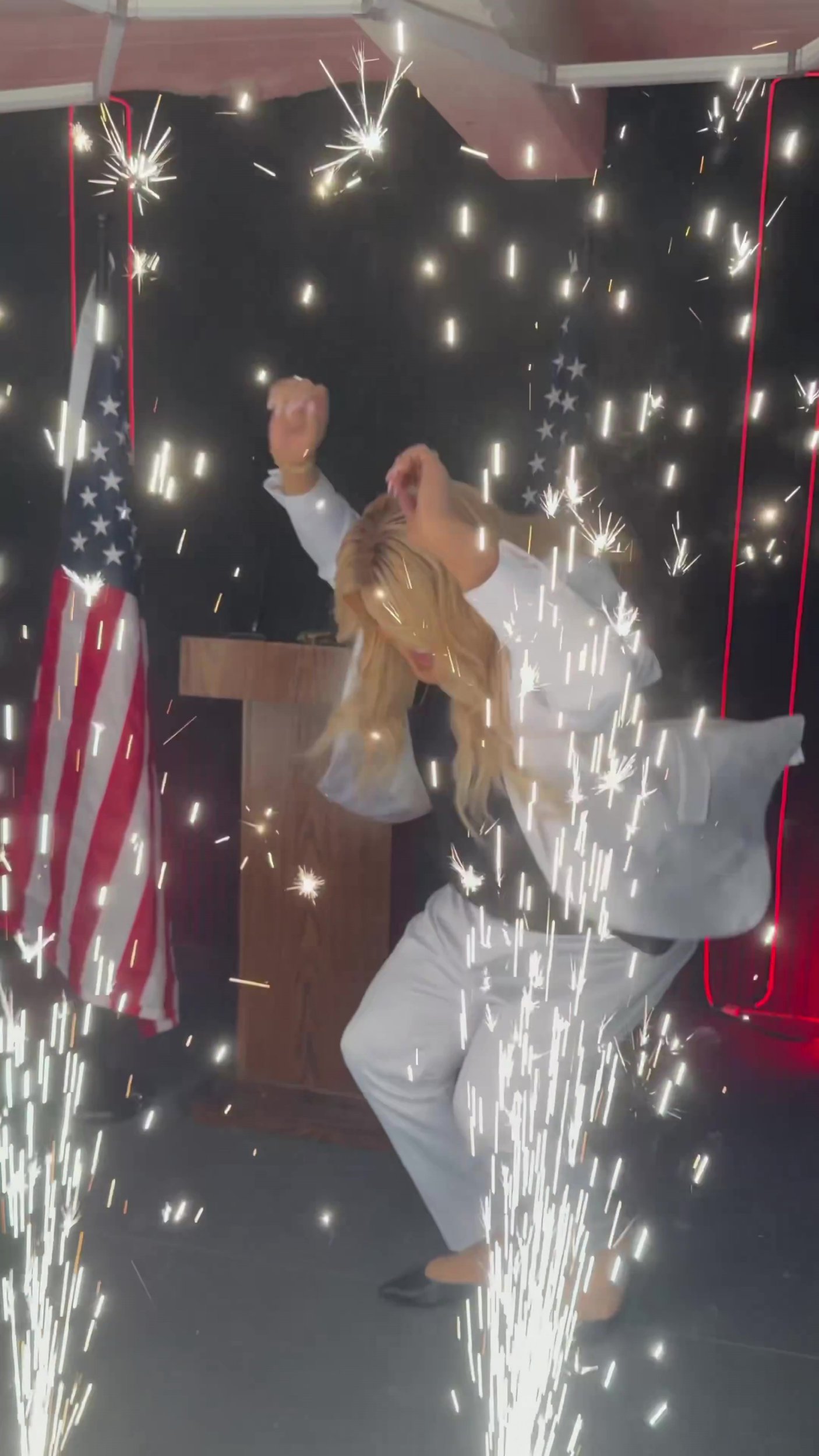
YouTuber Druski is at the centre of backlash following his latest viral sketch, which many have interpreted as a satirisation of Erika Kirk, Charlie Kirk’s widow.
Posted to X on March 25 with the caption ‘How Conservative Women in America act,’ the video shows Druski – who built his following through character-driven comedy skits – in full prosthetics, a blonde wig, and heavy makeup.
He then makes a theatrical stage entrance complete with fireworks, fixes the camera with an eerie, unblinking stare while clutching a Bible, and at one point declares, ‘We have to protect all white men in America, those are the boys that we care about in this country,’ while standing in front of a Black security guard.
The video has a shocking 54.7 million views on X at the time of writing, after being posted only yesterday.
Nowhere in the sketch does he name Erika, but several moments echo widely circulated clips of her, including her much-mocked, fireworks-heavy stage entrances and a viral video in which she repeatedly locks eyes with the camera in a way many found unsettling.
The resemblance was enough for audiences to draw their own conclusions, and they did so almost instantly.
Kirk’s late husband, Charlie, was fatally shot in September 2025 while speaking at an event organised by Turning Point USA. In the months since, she has been propelled into a highly visible leadership role, taking over as CEO of the far-right political organisation within days of his death.


Critics are arguing that Druski’s video is insensitive to Erika, a grieving widow.
Conservative commentator Jon Root wrote: ‘This is too far man… you’re making fun of Erika Kirk, whose husband was brutally assassinated. This ain’t it.’ Another user added: ‘We share a responsibility to know when something is too far… why does it have to be at the cost of a family this time?’
‘I am no way a perfect person, I don’t claim to be a perfect person…. I sure know I am not as gross and disgusting as failed “comedian” Druski dressing up as Erika Kirk mocking her for money and social media clicks.’ wrote one angry viewer.
Others, however, saw the backlash as missing the point. One supporter wrote: ‘Trolling Erika Kirk and all conservative white women, you might be the goat [greatest of all time].’
Another noted: ‘The prosthetics are so good that Grok literally identified him as Erika Kirk… he didn’t name anyone and he didn’t have to. The funniest part is watching people get mad about it because the anger is basically confirming the accuracy.’
While the parallels in Druski’s sketch are hard to ignore, the aim was clearly to satirise a specific archetype: a strain of conservative white womanhood defined by hyper-performative patriotism, evangelical language, and a highly curated, media-aware presentation of their own emotions.

That so many viewers immediately mapped that archetype onto Erika Kirk says as much about her public persona as it does about the sketch itself.
Erika has drawn plenty of criticism for the brand she’s curated since her husband’s death, and this is not the first time she’s been satirised online.
In a livestream shortly after his funeral, she framed her loss in militant terms, saying: ‘You have no idea the fire that you have ignited within this wife, the cries of this widow will echo around the world like a battle cry.’
She added: ‘If you thought that my husband’s mission was powerful before you have no idea what you have unleashed.’

At a major Turning Point USA conference just days after his death, attendees were met with a reconstruction of the scene of Charlie’s killing, where supporters queued to take photos.
When Erika took the stage backed by pyrotechnics and arena-rock production at her husband’s funeral, the internet quickly turned her into a meme.
But that reaction didn’t emerge in a vacuum.
Charlie built his platform on deliberately provocative rhetoric about race, gender, and religion, repeatedly drawing criticism for inflammatory and widely disputed claims designed to dominate attention.
And Erika has positioned herself as an even harder-line extension of that approach. During an episode of Charlie’s show before his death, when asked who was more conservative, he replied, ‘Erika by far… I am a moderate compared to Erika,’ a claim she readily endorsed.
Charlie’s public strategy was always clear: outrage as currency and spectacle as messaging. Erika has embraced that legacy, stepping into a role in which provocation and performance are inseparable from political identity.
Which is what makes the backlash to Druski’s sketch feel somewhat contradictory.
If a public persona is built on being loudly oppositional, on inviting reaction, and on turning politics into theatre, then objecting to satire—or even misdirected satire that never names you—begins to unravel that premise altogether.
Got a story?
If you’ve got a celebrity story, video or pictures get in touch with the Metro.co.uk entertainment team by emailing us celebtips@metro.co.uk, calling 020 3615 2145 or by visiting our Submit Stuff page – we’d love to hear from you.
