
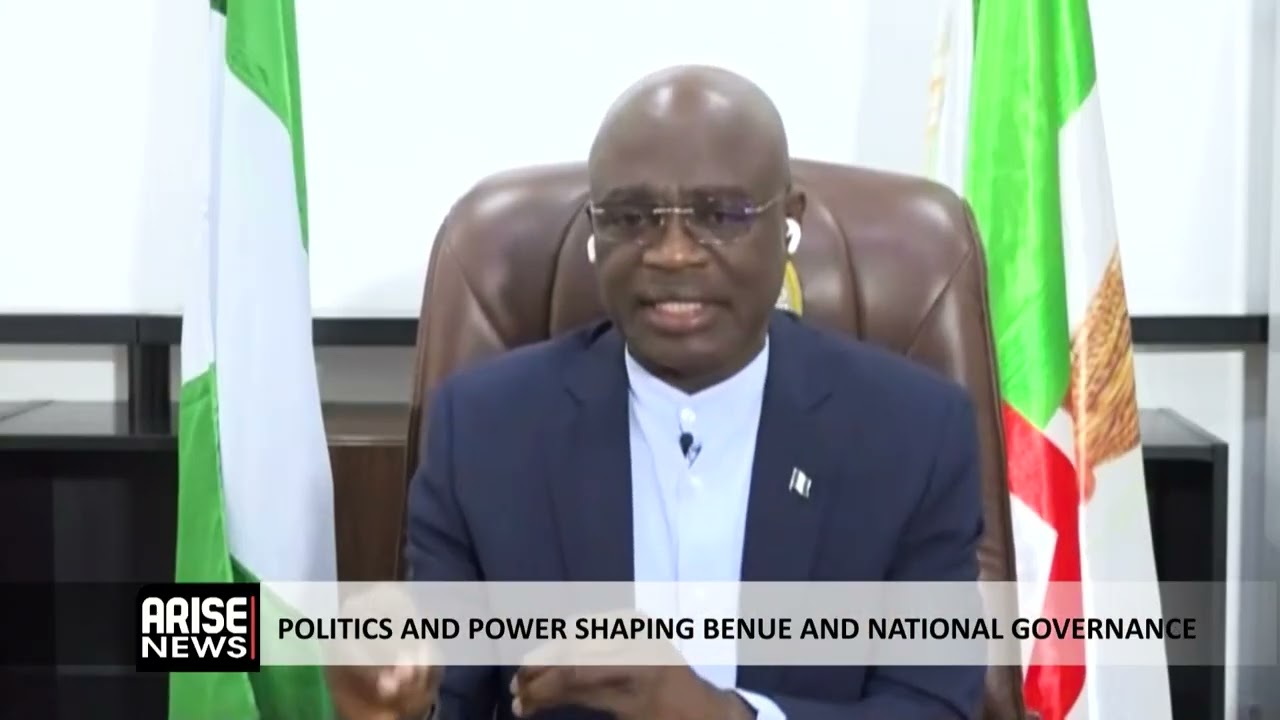
Retired Air Vice Marshal, (AVM), former Chief of Defense Intelligence, and the national coordinator of the Benue Rebirth Movement, (BRM), Monday Morgan, has alleged that Governor Hyacinth Alia’s administration is undermining democracy, internal inclusiveness and protection of rights within the Benue State chapter of the APC following the controversial disqualification of several aspirants ahead of the party primaries.
He said this while speaking in an interview with ARISE NEWS on Wednesday.
“In Benue politics, we have tribes, and tribes have aligned behind politics such that the Tiv nation, which is the biggest population, has become a hegemony. In that kind of situation, the dividends of democracy—which is internal inclusiveness and protection of rights—are completely negated. So, I think what is happening in Benue is a clear indication that they do not want politics and democracy to develop, because if you do not give a common ground for participation, you deny and disenfranchise certain personalities and certain groups of people,” he alleged.
Morgan further defended the BRM’s call for an Idoma governor, arguing that Benue South Senatorial District (Zone C) possesses the human and natural resources needed to lead the state.
“It has become so crucial because since the advent of this Republic in 1999 up to this moment. The Zone C is bigger than Ebonyi State; it is bigger than Enugu State. That is our zone, Zone C. And it has all the human resources that abound. We are talking about medical doctors; in Zone C alone, we have close to 40 retired generals. We have mineral resources in abundance: limestone, coal, kaolin, zinc, and lead. So, this is a very viable zone,” he explained.
Adding, he maintained that power rotation was necessary to promote equity and prevent future security challenges in Benue State.
“We anticipate that with the human resources and the global participation of our people—globally and nationally—we should have a system where rotation becomes important. Because if you use the tyranny of majority, it means you are creating some security challenges that will eventually emerge in Benue,” he warned.
Morgan also alleged that Benue South has been sidelined by the APC-led government, claiming that despite the zone’s vast resources, it has seen little development under Governor Alia.

“In the first instance, he accused Zone C of not supporting him. Ever since then, I have enumerated so many mineral resources that are in our environment. This Governor has not shown any project in our zone in terms of any rural development to show that Zone C belongs to Benue. I think the President should be briefed on Benue, because we are saddled with security challenges, and if care is not taken—if so many people are disenfranchised and people are neglected for so long—it can become another area of security challenges in the future,” he warned.
Calling for greater inclusion and power rotation in Benue State, Morgan insisted that Zone C has been neglected under Governor Hyacinth Alia, stressed that the BRM represents marginalised communities seeking fair representation and engagement in governance.
“The government is very far away from the people. BRM is the only platform that has been approved by all members of Zone C as the voice of the voiceless. We have other minorities in Zone A and B who are of the same ancestral relations with Idomas: the Jukuns, the Abakwarigas, the Nyiphons… these people rely so much on us,” he stressed.
Claiming earlier contribution to the state’s transition discussions, AVM Morgan said he submitted a security roadmap in 2023 alongside other retired military officers, but alleged that it was not implemented by the government.
“At the inception of this government, I was invited to be part of the transition government, and I gave him a security roadmap. Those were part of my recommendations as far back as 2023—that the first line of defense must be well-organized and structured. I gave him a very clear path for security success. I was in Makurdi with three other retired generals of repute, and we brought up this roadmap, neatly done, to even submit it officially to the Governor. It became a problem until I pursued him to his house to submit that document under a tree.”
On whether politicians are benefitting from insecurity, AVM Morgan said:
“I cannot say effectively that they are benefiting from insecurity.”
He also claimed that access to the governor for security consultations has been limited, even for senior retired generals, resulting in what he described as poor engagement with expert recommendations.
“I expect that a Governor has a lot of lack of knowledge in security areas. In Benue Zone C alone, where I come from, we have over 34 retired generals of repute. General Adoba recently took maps to meet with the Governor; he spent two days before he could see the Governor. By the time he gave him a military briefing on the best approach to counter the insurgents in our area, nothing came out of it. When he was going, I told him clearly: ‘This Governor doesn’t understand security, and he is not going to give a listening ear to you.’”
On the security roadmap he and other retired generals developed, Morgan said it proposed relocating IDPs and ensuring displaced children continue their education, alongside community-based support systems to reduce long-term displacement.
“In the roadmap that we gave to him, it was all-encompassing. Myself and three other retired generals who were my juniors, and some security experts of Tiv extraction, came together. We sat down and did a detailed approach of the roadmap: how to relocate the IDPs, and how to give them further education for those children that are not going to school. We did a classical job,” he emphasised.
Addressing underemployment among youths in Benue, the BRM national coordinator called for structured agricultural programmes, mechanised farming support, and government-backed cooperatives to engage young people productively and strengthen rural security.
“We are agrarian people; our land is fertile and the youth are strong and ready to work. What stops the government from having a program where every month, or every farming season, you empower the youth to go to particular lands and cultivate the type of crops that are an advantage economically in their zones? You have to help them. You can till the land, bring mechanical agricultural equipment to till the land, and supervise. Let them come together as cooperatives and work, and ensure the security within that zone is protected so that the herders do not attack them,” he advised.
He also warned that lack of job opportunities is pushing some youths into criminal activities.
“In fact, because of lack of jobs—the youth are collaborating with even the Fulani terrorists in the bush, and some of them have become part and parcel of kidnappers in so many of those zones.”
Addressing insecurity in Benue State, AVM Morgan called for stronger intelligence gathering, protection of vigilantes, and proper prosecution of arrested suspects, stressing that investigations should be evidence-based rather than generalised.
“Before you come up with any clear statement on those who are involved in the attacks, you must have a structured intelligence gathering mechanism. What we suggested was very simple: the first line of attack, you should protect the vigilantes and then train locals on how to do intelligence gathering. If there is a collaboration between the locals and the Fulanis to attack in an area, then the government should do something about that. But when you arrest them, what have you done? Have you charged them to court? Let some people be charged and found guilty,” he said.
He also urged reforms in military training and suggested restricting motorcycle imports, arguing they are commonly used to aid criminal mobility, while proposing alternative transport options to reduce reliance on them.
“I’d like to advise the Minister of Defense on several things right now. The Armed Forces must change its character in the way we train our boys. Religion should be completely de-emphasized from military training.
“What is happening is that the fluidity in which our bandits move must be checked. Today, what is their best weapon—their vehicles of operation? It is the motorbike. Why can’t Nigeria ban motorbikes completely for importation? Because the ubiquity of the bandits is based on the movement of motorbikes. I have suggested that motorbikes be banned in Nigeria,” he reiterated.
Stressing the need to target equipment used in attacks, Morgan said bandits rely on evolving tactics and must be countered with equally adaptive security strategies.
“Guerrilla warfare is not an easy war. So, the state must constantly look at the character of bandits, their approach to attacks, and how they disappear. They keep changing tactics; you have to change tactics to counter them. We must do a deliberate effort to dislodge their equipment. They mount GPMGs (General Purpose Machine Guns) on those bikes,” he urged.
Rejecting state policing, the retired AVM, Morgan warned it could concentrate excessive power in governors, but he proposed a zonal policing system jointly funded by regional governors to improve coordination and accountability.
“To the issue of state policing; a governor can become an emperor. I have said it a thousand times that state policing is a dangerous thing that we should never touch.
“Doesn’t this point to the need for a geopolitical response to insecurity in the form of state policing?
“I don’t believe in state policing because I have told you the danger of the mismanagement of state police. But if the geopolitical zones can fund police—like the North Central, for example, which has challenges here—all the governors can put their resources together and effectively fund a police system.
“If one man is tyrannical, four or five other people will not agree with him. So, there is a check and balance in the leadership of that zone to ensure effective policing. If the zones are created with police independence, it means the responsibility of that zone is in the hands of those governors and they cannot mismanage it.
“Let the President think about what I am saying. Before you go about state policing, you must bring experts. Let’s study what happens in other climes. The Nigerian system is multi-religious and multi-ethnic. It is not just a ‘straitjacket’ thing where you say state police works in America so it works here. It cannot,” he maintained.
Favour Odima