

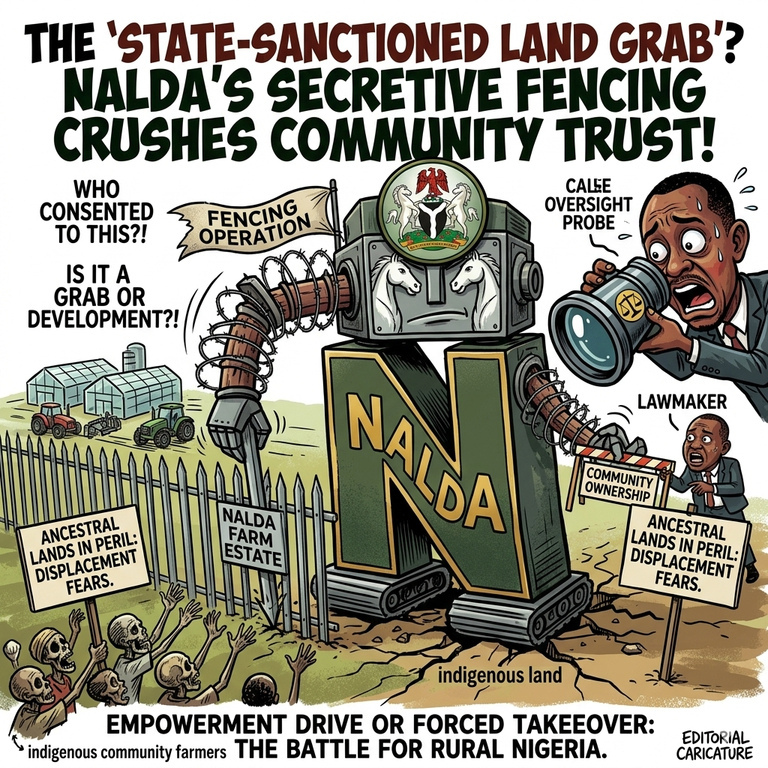
A fierce controversy is growing around the National Agricultural Land Development Authority (NALDA) and its integrated farm estate expansion and fencing — with critics now using explosive language:
“State-sanctioned land grab.”
At the heart of the uproar are allegations that ancestral lands in parts of the South-East and North-Central are being fenced off under agricultural development projects, triggering fears of displacement, inadequate compensation, and broken promises to rural communities.
The accusation is dramatic:
Are integrated farm estates reviving agriculture or quietly uprooting indigenous farmers?
NALDA says that framing distorts what is actually a food security and rural development strategy.
But the backlash is growing.
Land Fencing by NALDA: Farming Development or Forced Takeover?
Community critics and traditional stakeholders allege that thousands of hectares tied to federal farm estate plans are being acquired in ways they describe as aggressive or opaque.
Their concerns include claims of:
- Land demarcation without sufficient consultation
- Compensation disputes
- Fears of indigenous farmers losing long-held access
- Promised youth employment not materializing quickly enough
Some critics say fencing activities symbolize something deeper:
- Not development.
- Displacement.
And that has fueled talk of “local uprisings.”
Why the “Land Fencing by NALDA” Narrative is Catching Fire
The controversy is emotionally potent because land is not merely economic. It is identity, inheritance, and history.
So when critics frame agricultural fencing as threatening ancestral land, the issue instantly moves beyond policy into existential fear.
That is why the narrative has gained traction.
NALDA’s Position: This Is Farm Infrastructure, Not Land Seizure
NALDA and supporters strongly reject the “land grab” characterization. Their argument is that integrated farm estates are designed to:
- Expand food production
- Open idle or underutilized land for cultivation
- Create jobs in rural communities
- Support mechanized agriculture and agro-industrial growth
In that framing, fencing is not dispossession. It is infrastructure.
Supporters argue perimeter control protects investments, secures farm estates and organizes production. Not communities out.
The Food Security Argument
NALDA supporters place the controversy within a bigger national urgency: Food security.
With rising demand and pressure on agriculture, they argue Nigeria cannot expand output without larger coordinated farming systems.
Integrated farm estates, they say, are meant to support:
- Import substitution
- Rural industrialization
- Youth agribusiness participation
- Scaled production clusters
Seen this way, the projects are framed as a national necessity. Not territorial encroachment.
NALDA’s Land Fencing: Where is the Place of Consent?
Still, critics keep returning to one issue: Consultation. They argue that even worthy development goals can trigger conflict if communities feel decisions are imposed.
Their point is blunt:
Development without consent can feel like dispossession and that is where tensions intensify.
The Youth Employment Promise Debate
Another flashpoint is the allegation that promised “re-employment” opportunities for local youth have lagged.
Critics say communities were told integrated estates would generate immediate inclusion.
Some now ask: Where are the jobs?
Supporters counter that such projects scale in phases and employment impact takes time. But perception gaps remain.
Is This Land Grab by Fencing From NALDA or Development Politics?
Supporters say the phrase “state-sanctioned land grab” is inflammatory and politically charged.
They argue it ignores:
- Existing public development frameworks
- Community engagement efforts
- The economic rationale behind farm clustering
To them, critics are weaponizing fear around land to delegitimize agricultural modernization. That claim has become part of the dispute.
Why This Debate Runs Deeper Than NALDA
Analysts note the controversy reflects an old African development tension: How do states expand strategic projects without triggering fears of extraction?
It is a recurring challenge. Because land reform often sits where development and identity collide and neither side treats that lightly.
Perception vs Project Design
Even supporters admit one thing: Optics matter.
When fences appear before trust does, suspicion grows. And where communication is weak, rumor fills the vacuum.
That may be part of what is happening here.
A More Difficult Truth
Perhaps the issue is not whether NALDA is displacing communities or empowering them.
But whether agricultural transformation can succeed without stronger community ownership.
That may be the harder lesson beneath the outrage.
Conclusion: Secretive Fencing Operation or Food Security Misread?
The outrage from community members about their ancestral lands being in peril is powerful because it captures a primal fear.
- Loss of land
- Loss of control
- Loss of belonging
Critics warn integrated estates could become instruments of displacement. NALDA says they are engines of empowerment.
Both claims raise serious questions and perhaps the real challenge is this:
Can Nigeria modernize agriculture at scale without making rural communities feel pushed aside by the very projects meant to uplift them?