

Bulgaria’s caretaker agriculture minister says he is racing to confront deeply entrenched corruption tied to EU farm subsidies, food safety inspections and organized crime networks.
Ivan Hristanov lacks both time and an electoral mandate — awkward starting conditions for an aspiring graft fighter. But for at least a few months he will hold the levers of power, and claims to know how to use them.
“We’re not coming here with a dream,” he told POLITICO. “We’re coming with a plan.”
That plan involves the basic law enforcement tools of audits and indictments, yes. But he’s also taking a cue from opposition firebrands in the U.S., like Alexandria Ocasio-Cortez and Zohran Mamdani, to drum up public pressure.
In recent weeks he has livestreamed inspection visits, previewed corruption complaints on Facebook, and posted video explainers naming alleged subsidy scams.
“Sometimes media attention is more powerful than changing a law,” he said. “When everyone is watching, it becomes much harder to reverse things.”
Appointed on Feb. 18 in an interim government steering Bulgaria toward snap elections on April 19, he argued the mandate is long enough to reopen investigations that were shelved by previous administrations.
“If we cannot close every case, we can at least put them in a position where the outcome becomes unavoidable,” he said.
Bordering on fraud
Long ranked among the EU’s most corrupt countries, Bulgaria has faced persistent allegations that political and business networks siphon off national and EU funds.
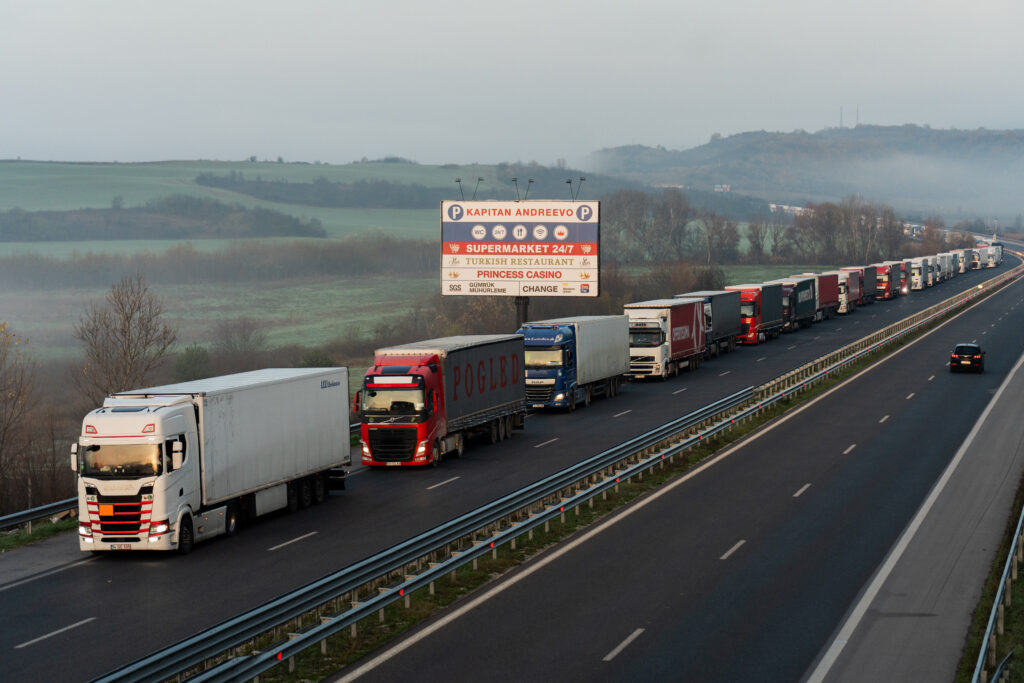
Hristanov first made headlines in 2022, when, as deputy agriculture minister in Kiril Petkov’s reformist government, he warned that the country’s Kapitan Andreevo checkpoint — one of the world’s busiest land crossings, connecting the EU and Turkey — had effectively become a “private border.” Food safety inspections there were handled by a private laboratory linked to criminal interests, he said.
Hristanov launched investigations into the inspection regime, pitting him against business interests and lawmakers accused of protecting them. But Petkov’s government collapsed months later amid coalition infighting, leaving the effort unfinished. Controls have improved since 2022, but trafficking networks remain active, Hristanov said.
This time, the crackdown extends far beyond the crossing.

Officials are reviewing subsidy claims involving what Hristanov describes as “fields that never existed” and “animals that never existed,” echoing fraud cases uncovered in neighboring Greece, where agricultural payments were claimed for farms that existed only on paper.
Authorities are also revisiting Bulgaria’s “guesthouse scandal,” in which EU rural development funds allegedly financed private villas linked to politically connected figures. Food safety inspectors themselves are under scrutiny after small producers reported being pressured to pay protection money.
The sums at stake are substantial. Since joining the EU in 2007, Bulgaria has received well over €10 billion under the Common Agricultural Policy. Another €5.6 billion is allocated for the current funding cycle, which runs until 2027.
The European Public Prosecutor’s Office, which investigates fraud involving EU funds, is already looking into more than 70 agriculture-related cases in Bulgaria as part of hundreds of active probes in the country.
Hristanov said his ministry is preparing dozens more for referral.
“With more time, the cases would be in the hundreds,” he said.
Reality check
Not everyone believes the caretaker government, which will remain in place only until a new administration is formed, can achieve major progress.
“His hands are tied,” said Radosveta Vassileva, an adjunct senior research fellow at University College Dublin’s Sutherland School of Law, arguing that key institutions responsible for tackling corruption remain politically captured and beyond the reach of short-term ministerial action.
Others say the short mandate doesn’t mean the effort is meaningless.
Hristanov could still “shed some light on illegal practices,” replace compromised officials or pass information to prosecutors and EU investigators, said Lora Georgieva of Bulgaria’s Anti-Corruption Fund foundation. Once cases are taken up at that level, she added, they are harder for future governments to ignore.
Indeed, Hristanov — who broke away from a centrist party to form his own anti-corruption movement, Edinenie (Unity), in 2023 — has turned social media into a continuous feed of investigations.
On his personal Facebook page, which has more than 120,000 followers, he posts short video statements announcing new cases, livestream-style explainers of alleged corruption schemes, and clips from television interviews in which he walks viewers through specific allegations.

Inspection visits appear as vlog-style updates filmed on the road or outside regional offices, sometimes with hashtags and calls for followers to share the posts. Documents and complaints filed with prosecutors are also teased online before formal announcements, a tactic Hristanov says is meant to make it harder for institutions to shelve cases quietly.
A long-running problem
Corruption scandals have repeatedly fueled political instability in Bulgaria.
Critics say oligarch networks retain influence across the judiciary, media and parts of the state, with EU funding often serving as a source of patronage. Powerful political allies in Brussels, particularly from Europe’s dominant center-right European People’s Party, have also faced criticism for backing Bulgarian allies during earlier corruption crises.
The latest upheaval came in late 2025, when protests forced conservative Prime Minister Rosen Zhelyazkov to resign, paving the way for the caretaker cabinet now overseeing yet another snap election.
Opposition figures have called for Hristanov’s resignation, accusing him of politicizing the ministry and neglecting day-to-day farm policy. He dismisses the allegations.
“I can only laugh at that,” he said.
For him, the fight extends beyond one ministry — or even one election.
“If Bulgaria wants to catch up with the rest of Europe,” he said, “we have to become a country where corruption is the exception, not the system.”