

When I arrived in the Italian Dolomites for a ski holiday, I didn’t foresee myself naked in a bath of hay with a stranger standing over me.
And while I had hopes that it would soothe my bones after a day on the slopes, it turns out that being tightly wrapped in herb-enriched grasses is dreadfully, wickedly uncomfortable.
A centuries-old practice in this part of the world, hay baths were first mentioned in a travel guide about the Dolomites written by two Englishmen, Gilbert and Churchill, in 1864.
And the good folks at the Heubad Hotel, not far from Bolzano, have been providing them for more than 100 years.
The hay, which grows on the famously fertile mountainsides, is rich in natural benefits. According to the hay bath specialists of South Tyrol, these include the easing of rheumatism and general aches and pains, the boosting of the immune system, improved circulation, weight loss and all-round revitalisation.
That’s all fine and well, but it borders on the excruciating. I’ve never felt so itchy, nor so grateful not to suffer from hayfever.
Best of Metro Deals
Get exclusive discounts with Metro Deals – save on getaways and spa days. Powered by Wowcher
Bannatyne Spa: Spa day for two with treatments, lunch & prosecco — save up to 57% off.
Mystery Escape: Hotel stay with return flights from as low as £92pp — save on worldwide holiday packages.
Beach Retreat (Lanzarote): 4* Lanzarote beach holiday with flights — save up to 58%.
There’s a lot to be said for fluffy robes and aromatic oils.
A sauna here, a private jacuzzi there
Thankfully, there are more spas in the area. For my first night in the Dolomites, I check into the Tratterhof Mountain Sky Hotel, which has four stars and a snazzy wellness area.
We’re talking eight saunas, two infinity pools, and, the best part, a jacuzzi on the balcony of my room.
There’s nothing quite like slipping into your own personal hot tub accompanied by nothing but the twinkling night sky.

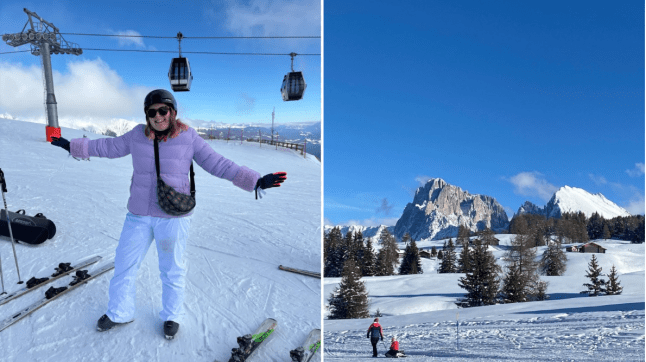
Washed and well-rested, it’s time to hit the snow at Gitschberg Jochtal, which has around 25 runs and 15 lifts.
I was lucky to ski a few times as a child. Back then, I had little fear and would throw myself down the slopes with complete confidence. As an adult, though, I’m less assured.
That’s why I’m here. With more than 500km of terrain, Val Gardena caters to skiers of all abilities.
There’s a fair amount of blue slopes (there’s no such thing as green in Italy, in case you’ve encountered that system elsewhere in Europe), and no risk of swerving onto a black route accidentally.

There are 12 resorts across the Dolomiti Superski area, all joined together with one universal ski pass, which means you can hop around a bit.
Pros will be familiar with The Legendary 8 slopes. All form a special part of the area’s sporting history, including Cir, the route that was taken by the women competing at the Alpine World Ski Championships in 1970, and Bravo, known as the ‘romantic slope.’
If you’re confident going in for the long haul, try Sellaronda, which spans around 40 kilometres (just over 24 miles). It takes about six hours and runs through four areas of the ski pass section.
Despite having family in Italy, I had never skied there. But it trumps every experience I’ve had in Austria and France. It sounds obvious, but it reminds me that Italy is much more than a summer destination.

Food for thought
We stop for lunch at the Gitschhütte, a mountain hut that serves traditional Tyrolian dishes.
When I’ve skied elsewhere, particularly in France, I’ve packed sandwiches to avoid spending outrageous money on average grub.
But in Italy, prices are more reasonable, even when you’re refuelling next to the slopes.
An Aperol Spritz is around €5, a bowl full of Knödel – bread dumplings stuffed with spinach and cheese – about €12.
Apparently, it’s rude to eat these with a knife, as the chef will assume they weren’t cooked well enough.

I didn’t expect food to be a standout on this trip, but I am happy to be wrong.
Dinner at Hotel Schgaguler reveals another side of the Dolomites. We try local specialities such as potato gnocchi and braised lamb loin, finished with a gorgeous hazelnut plumcake.
The evening rounds out with a mini wine tasting session guided by a local sommelier called Sandra. There are earthy reds and zesty whites, and as I retire to bed, belly stuffed and legs aching, I reflect on how much the Dolomites have to offer beyond its snowdusted slopes.
I will return — but I won’t be having a hay bath.
Getting there
SkyAlps flies three times a week from London Gatwick Airport to Bolzano. Return flights start at £273.
Eleanor was a guest of South Tyrol Tourism, but don’t expect us to sugarcoat anything – our reviews are 100% independent.
Rooms at TRATTERHOF Mountain Sky Hotel Dolomites start at £126 per night. Rooms at Hotel Schgaguler Hotel start at £303 per night. The Dolomiti Superski Pass starts from £67 per day.
Do you have a story to share?
Get in touch by emailing MetroLifestyleTeam@Metro.co.uk.