
ATHENS — Greece’s stellar economic growth does not depend on servicing the Russian oil industry.
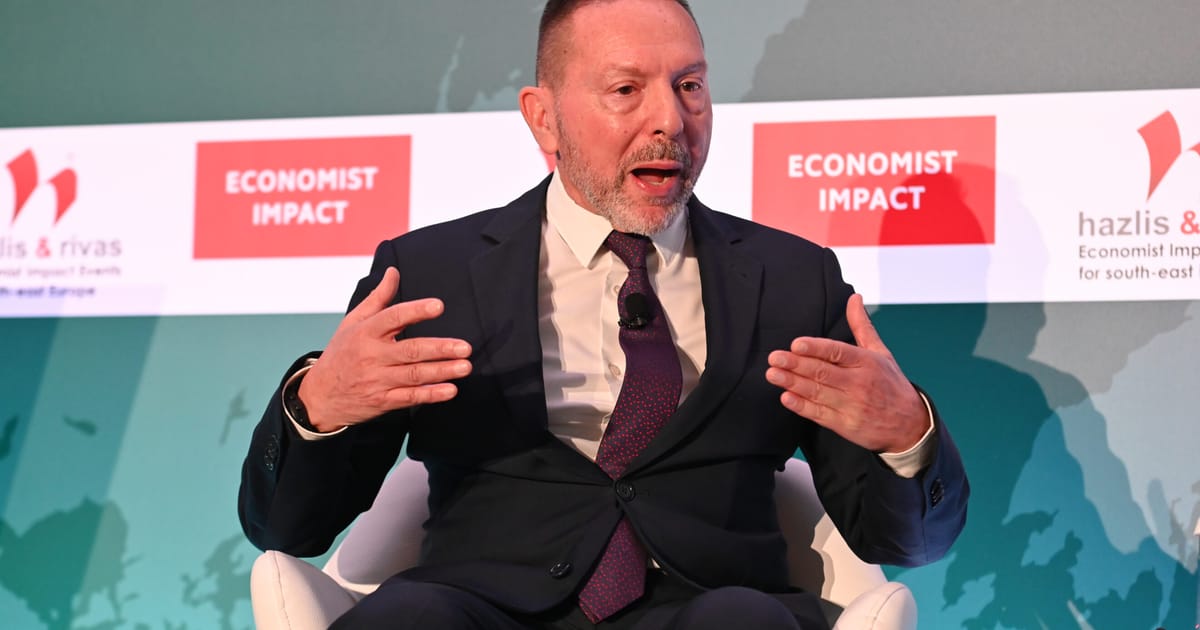
That’s the message from Greek central bank governor, Yannis Stournaras, amid accusations that Athens is protecting its national economic interests by blocking an EU ban on servicing ships carrying Russian crude oil.
The ban is central to the European Commission’s latest draft package of sanctions against Moscow’s war economy, as Russia’s war on Ukraine approaches its four-year mark. Negotiators in Brussels are pointing at Greece and Malta as the main hold-outs over the maritime servicing ban, as they rush to agree the package before Tuesday’s planned unveiling.
While Greece’s maritime sector still accounts for roughly 7 percent of its economic output, Stournaras dismissed suggestions that shipping — let alone Russia-related shipping — underpins the country’s growth.
“It’s not like in the past. It is not only tourism and shipping,” Stournaras told POLITICO in an interview from his office. He stressed that his government, under the leadership of Prime Minister Kyriakos Mitsotakis, has stood fully behind Brussels’ support for Ukraine.
The 69-year-old pointed to the volatile demand for maritime services. Receipts show the industry has been far too erratic to underpin Greece’s successful economy, which the Bank of Greece forecasts will grow by 2.1 percent this year.
“After a strong post-pandemic rebound, [receipts] declined by around 13 percent in 2023, remained broadly flat in 2024 and are expected to decline by roughly 15 percent in 2025,” he said. “The trajectory clearly diverges from Greece’s overall growth performance.”
Stournaras pointed to the massive expansion of its pharmaceutical sector as evidence of Greece’s diversifying economy. The sector provides some 10 percent of Europe’s drugs.
In the past, MEPs have called on Mitsotakis to crack down harder on Greek shipowners who have made billions from selling older tankers to Russian companies that help move contraband oil.
Athens has previously said it’s doing everything to ensure compliance with the sanctions. But it doesn’t fully agree with the latest measures in Brussels’ 20th package against Russia.
The Greek position in Brussels is that implementing a full maritime ban would benefit Indian and Chinese shipping, at the expense of Europe, according to diplomats familiar with the negotiations. Disrupting the production and transport of oil will also lead to higher prices, the argument goes, boosting Russian revenues.
That said, current and future Russian sanctions pose no serious risk to the national economic outlook, according to Stournaras. Growth will primarily be driven by domestic demand, investment spending, and private consumption. He expects the economy to expand at a solid rate of around 2 percent in 2027 and 2028.
This would keep Greece outperforming most of the eurozone in what has been one of the brightest success stories after its economy shrank by around a quarter during the sovereign debt crisis.
“Greece has changed a lot,” he said.